





2026 Transformation Agenda: How Investment Firms Are Transforming for Growth, AI and Scale
-1.png?width=48&height=48&name=Untitled%20design%20(12)-1.png)
Co-authored by David Higgins and Tom Secaur
Citisoft’s 2026 Transformation Survey gathered insights from over 65 asset managers, asset owners, and insurers. The survey was designed to offer a unique statistical perspective to enable firms to benchmark their own transformation agenda.
.png?width=600&height=400&name=Website%20-%20Resources%20-%20News%20%5B600x400%5D%20(8).png)
Executive Summary
The 2026 Transformation Survey reveals an industry grappling with growing operating model complexity. Drawing on responses from firms ranging from global institutions to agile mid-sized managers, the findings show that while many pressures are shared across the market, the most revealing differences emerge by AUM. It is here that transformation priorities, operating model challenges, and approaches to growth begin to diverge.
Growth ambitions are compounding demands on firms. Expansion in AUM, product offerings, geographic footprint, and distribution channels is placing increasing strain on operating models, challenging their ability to scale, govern, and integrate. At the same time, firms are adapting to the demands of private markets, broader investment strategies, and more complex data requirements. In response, firms are pursuing a combination of AI initiatives, data transformation programmes, and platform rationalisation efforts to improve scalability, efficiency, and control.
Three themes dominate this year’s findings. First, firms are racing to operationalise artificial intelligence. AI adoption is the most widely prioritised area of transformation, with 61% of firms identifying it as a top priority and 97% expecting it to play some role in achieving their transformation objectives. Investment research has emerged as the leading deployment area, while data analytics and data architecture are also prominent areas of investment. Larger firms are increasingly extending AI into client-facing and product-oriented functions, suggesting adoption is spreading across the operating model.
Second, firms increasingly recognise that complexity cannot be managed without better data foundations. Across data architecture, governance, operations and analytics, 95% of firms are planning change in at least one data function over the next three years. The highest concentration of activity sits in data architecture and governance, suggesting firms increasingly recognise that successful AI adoption depends on trusted data, integrated platforms and scalable operating models. While AI may feature prominently in strategic discussions, the survey indicates that data modernisation is where the most widespread transformation activity is occurring.
Third, firms managing between $100 billion and $500 billion AUM have emerged as the industry's complexity inflection point. These organisations are balancing growth ambitions with rising operational demands driven by private markets, broader investment propositions and increasingly diverse operating models. Private asset participation is almost universal within this segment, yet approaches to managing those assets vary considerably. As a result, transformation is increasingly focused on strengthening the connections between front-office capabilities, data, platforms and operational controls to support future growth.
The defining challenge for investment managers is managing complexity. Firms that successfully connect data, platforms, and investment capabilities will be best positioned to support growth and scale innovation.

Current State
Where the Industry Stands Today
The Transformation Survey 2026 data provides a snapshot of where the industry stands today. By examining operational footprints, asset class strategies, and technology ecosystems, we can establish a baseline for understanding the transformation journeys ahead. These insights reveal the diversity of operating models, regional presence, and the maturity of data integration across the front-to-back office.
Operating Models Depend on Interoperability
Most firms do not operate through a simple choice between internal and outsourced delivery. Instead, they combine in-house expertise with third-party technology and external servicing across core investment and operational functions.
85% of firms use outsourcing somewhere within their operating model, while every respondent firm relies on externally provisioned technology in at least one area.
Yet standardisation remains incomplete. One-in-three firms continue to use manual processes within their operating model, highlighting the persistence of operational workarounds even as firms invest in automation, platform modernisation and service-provider relationships.
This pattern is particularly evident in operationally intensive functions.
- Fund accounting and administration is predominantly delivered through outsourced models, with almost three-quarters of firms either outsourcing the function entirely or combining outsourced servicing with in-house platform capabilities. Where these hybrid models exist, firms are also more likely to retain some level of manual reconciliation.
- Similarly, 86% of respondents deliver IBOR capabilities through a combination of third-party platforms and outsourced or managed services, underscoring the extent to which core investment operations depend on external technology and service-provider ecosystems.
The same dynamic extends into front-office support functions. Investment research is overwhelmingly technology-enabled, with most firms relying on proprietary tools, third-party solutions, or a combination of both.
The findings suggest that operating model design is becoming less about choosing between in-house and outsourced delivery and more about orchestrating a network of internal capabilities, third-party platforms and service providers while maintaining effective oversight, governance and integration.
Investment Diversification is Reshaping Management Decisions
That coordination challenge is becoming more significant as firms expand across asset classes. Private market participation is now close to universal among respondents, while digital assets have expanded beyond niche managers and appear in portfolios across firms of varying sizes. These asset classes bring distinct valuation, liquidity, data, and operational requirements that can be difficult to accommodate within operating models originally designed to support public market assets.
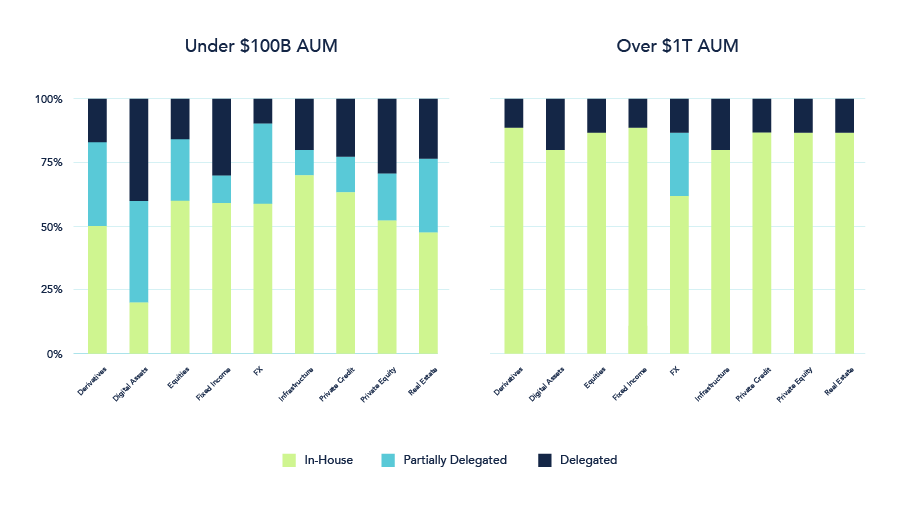
Firms are responding with increasingly flexible approaches to capability delivery. Traditional investment activities remain predominantly managed in-house, while newer and more specialised asset classes are often supported through a combination of internal expertise, delegated providers, and specialist partners. There is no singular approach. Decisions depend on where firms have sufficient expertise and scale internally, and where external support offers a more practical route to market.
The result is that investment diversification affects more than the product range. It increases the number of management and delivery models firms must support, creating additional demands across data, governance, oversight and integration.
Firms are becoming more selective about where they build capability internally and where they rely on external partners. While this approach can support growth and accelerate access to new markets and asset classes, it also creates a more complex operating environment that must be governed, integrated, and controlled effectively.
Market Expansion Does Not Always Mean Operational Replication

The survey data provides insights into how firms distribute capabilities across locations. Firms with a physical presence across multiple regions are more likely to locate investment, distribution and client-facing functions across several locations. However, the data suggests that firms are not replicating every capability wherever they establish a presence.
Operational, data and technology capabilities appear to be concentrated in a smaller number of locations than client-facing activities. This suggests that geographic expansion is often achieved through the selective placement of capabilities rather than through the duplication of complete organisational structures.
Larger organisations are more likely to establish local distribution, investment, or client-facing teams while continuing to support those functions through operations, data and technology capabilities located elsewhere. This enables firms to build a local presence without duplicating the full supporting infrastructure. Those with less AUM, but operating across multiple regions, are more likely to co-locate front-office and support functions within the same geography.
This should not, however, be interpreted as an argument for any single operating model. Rather, it highlights how geographic expansion increasingly requires firms to make deliberate, function-by-function decisions about which capabilities should be centralised, delivered through centres of excellence, or co-located with the teams they support. As organisations scale, competitive advantage comes not from replicating entire operating models across regions, but from balancing global efficiency with the local alignment required to support growth.
Taken together, these findings point to an industry supporting broader investment mandates through increasingly interconnected operating models. Firms are managing more asset classes, more delivery models, and more technology dependencies than ever before, creating growing demands on data, governance and operational control.
Scale is increasingly being achieved through coordination rather than replication. Firms are establishing regional hubs, combining internal and external delivery models, and relying on increasingly interconnected ecosystems of technology providers and service partners.
The objective is growth, but more specifically, growth delivered efficiently. As operating models expand, many firms are looking to simplify technology landscapes, reduce duplication across systems and processes, and rationalise capabilities that have accumulated over time. This flexibility can support AUM growth and market expansion, but it also increases the importance of integration, oversight, and operational resilience.
Understanding how your organisation compares against these industry benchmarks is often the first step in identifying where operating model strengths and constraints exist. Citisoft's strategic assessment services help firms benchmark their operating model, data, technology, and organisational capabilities against peers and identify opportunities for improvement.
How does your operating model compare?
Speak with our team to benchmark your organisation against firms of a similar size, operating profile, and transformation maturity.
Transformation Priorities
Where Firms are Investing Next
The asset management transformation agenda is being shaped by two forces in parallel: the pursuit of operational efficiency and the need to support future growth.
While AI is at the forefront of industry discussion, the survey suggests firms are pursuing artificial intelligence as part of a broader operating model transformation agenda rather than as a standalone technology initiative.
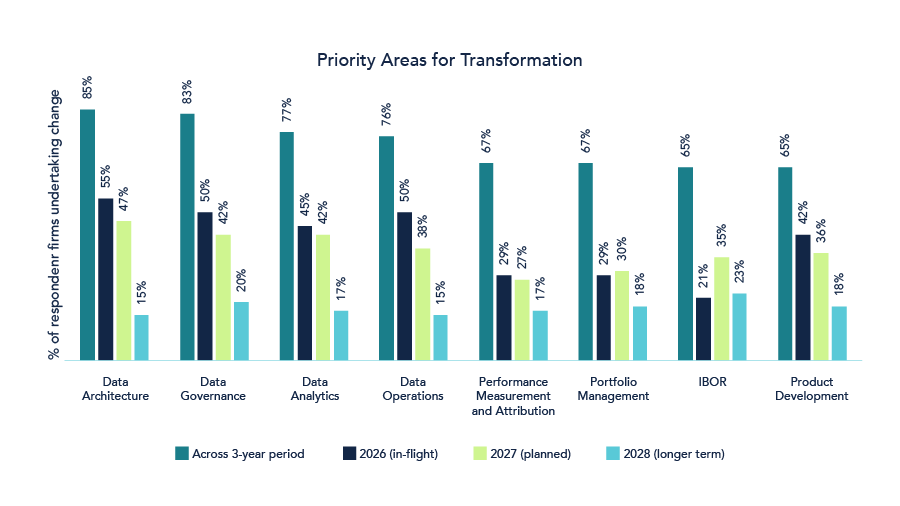
Looking across transformation roadmaps, a clear hierarchy of priorities emerges. Data functions dominate planned activity over the next three years, with data architecture, governance, analytics, and operations representing the highest concentrations of change. However, transformation is not confined to the data ecosystem. Approximately two-thirds of firms are also planning changes across performance measurement and attribution, portfolio management, investment book of record (IBOR), and product development, suggesting that change is increasingly moving into core investment processes and front-office capabilities.
Efficiency remains a powerful driver for transformation investment
More than nine in ten firms cite operational efficiency as a key transformation objective, with priorities centred on automation, process simplification, supplier rationalisation, productivity improvements, and overhead expense reduction. The goal is not simply to modernise technology, but to simplify increasingly complex operating environments and create more scalable foundations for future growth.
Data modernisation sits at the centre of this effort
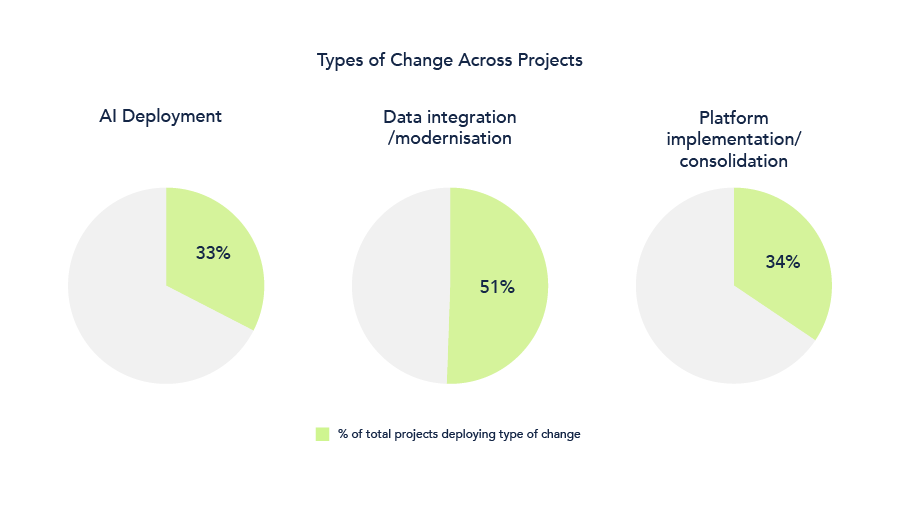
Firms are rationalising or replacing legacy systems, integrating core platforms, and reducing fragmented vendor ecosystems. This is particularly evident among larger organisations, where scale has often been accompanied by technology sprawl, operational complexity, and growing demands for interoperability across the investment lifecycle.
Yet transformation is being pulled by AUM growth and asset class diversification as much as efficiency. Further expansion into private markets, ETFs, digital assets, distribution channels, and new geographies is creating fresh demands on data, technology, and operating models. The findings suggest firms are investing to improve today's operations and build the capabilities required to support tomorrow's investment strategies.
What this means: Data transformation, platform modernisation, and operating model simplification remain the foundations of long-term competitiveness. Speak with our team to see how your organisation compares against industry benchmarks.
AI Adoption
The Race to Operationalise AI
Artificial intelligence has become the theme du jour in transformation conversations. It shapes conference agendas, vendor roadmaps, industry commentary, and an ever-growing number of business cases. Yet for all the discussion, there is still surprisingly little clarity on where firms across the market are deploying AI, how widespread adoption is, and what business problems they expect it to solve.
The survey data provides some much-needed perspective on where firms are directing investment today and where adoption is expected to accelerate through 2027.
At a strategic level, the direction of travel is unmistakable. AI adoption is the most widely prioritised area for transformation over the next 12 months, with 61% of firms identifying it as a top priority. That figure rises to 97% when including firms that believe AI will play some role in achieving their transformation objectives.
Despite the hype that often surrounds the technology, respondents are largely approaching AI through a pragmatic lens. Responses point to a focus on automating manual processes, improving operational efficiency, enhancing research and analytical capabilities, and embedding AI across front-, middle-, and back-office workflows. In other words, firms are less concerned with AI as a standalone innovation story and more interested in its potential to address longstanding operational and business challenges.
How asset managers are deploying AI across the operating model
Looking beyond strategic intent, the transformation roadmaps reveal where firms expect AI deployment to occur over the next three years. Investment research emerges as the most common target across all AUM bands, and data analytics and data architecture feature prominently across the market. While larger firms are increasingly extending AI adoption into client-facing and product-oriented functions.
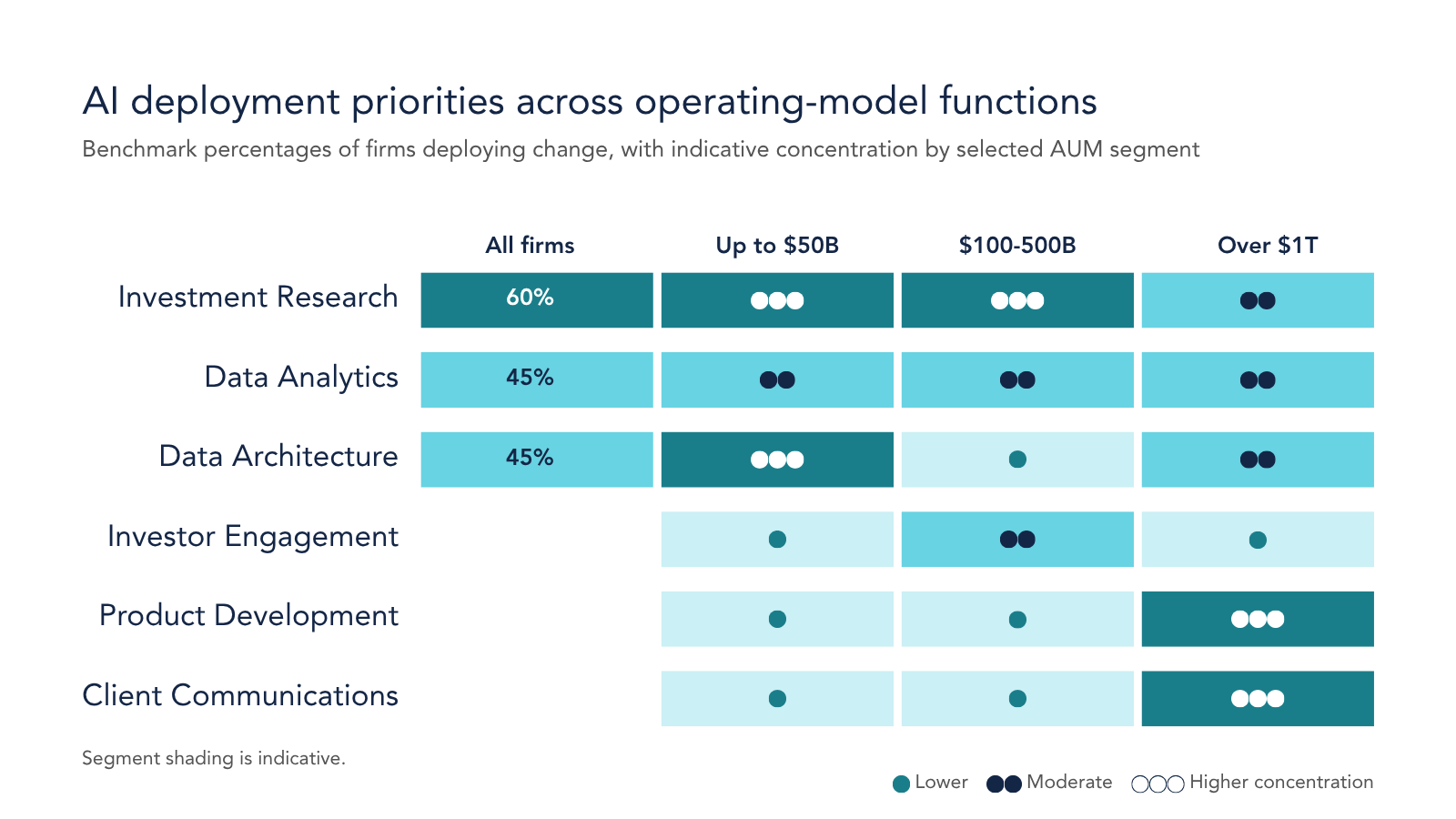
Investment research becomes a practical AI priority
Investment research has emerged as one of the most active areas of AI-driven transformation. Two-in-three firms plan to transform their investment research capabilities over the next three years. These programs are primarily growth-oriented, with asset class expansion and evolving client demand acting as supporting catalysts.
AI sits at the centre of this agenda. Around 70% of firms undertaking investment research change in 2026 are planning to deploy AI, making it the most common change initiative across the function. Notably, a quarter of firms deploying AI are pairing it with data integration and modernisation efforts, highlighting the close relationship between AI adoption and improvements to the underlying data foundation. The pace of delivery is also notable: only one in ten investment research projects extend beyond a year.
The findings suggest that firms increasingly view AI as a practical tool for enhancing research processes rather than a standalone innovation initiative. The ability to aggregate information, surface insights, and support faster decision-making appears to be driving adoption.
Delivery complexity emerges as the key AI constraint
Encouragingly, broader investment research transformation programs are progressing as planned. However, AI deployment introduces an additional layer of delivery complexity, with approximately one in four AI-related initiatives encountering roadblocks. Respondents most frequently cite unclear or evolving requirements as the primary cause. This is perhaps unsurprising given that many of these initiatives are tied to broader growth agendas, including market expansion, new product launches, and asset class diversification, all of which can introduce additional requirements beyond the original programme scope.
More broadly, implementation complexity remains a challenge for AI programs across the operating model. Of the firms planning AI deployment, 42% have encountered obstacles, most frequently citing legacy technology and internal dependencies, followed by resourcing and expertise gaps.
Priority Area for Transformation
Why Data Transformation Continues to be a Priority
Data remains one of the industry’s most enduring transformation priorities. This year’s findings reinforce that trend, with 95% of firms planning change across at least one data function, spanning data architecture, governance, operations, and analytics, over the next three years. The highest concentration of activity is expected to continue from this year well into 2027, indicating that firms are prioritising data transformation now rather than treating it as a longer-term objective.
The finding is particularly significant in the context of AI. While artificial intelligence is informing strategic agendas, the survey suggests firms increasingly recognise that successful AI adoption depends on the foundations beneath it: trusted data, effective governance, integrated platforms, and scalable operating models.
Data is not a new priority, but the scale and concentration of planned activity suggests firms are increasingly moving to address long-standing challenges around integration, governance and fragmentation that have constrained transformation efforts for years.
Current state: Data management today
Data management is increasingly platform-led, but the operating model is far from standardised. Vendor platforms are the dominant approach, used by 80% of firms surveyed, yet many organisations continue to combine proprietary platforms, managed services and manual processes.
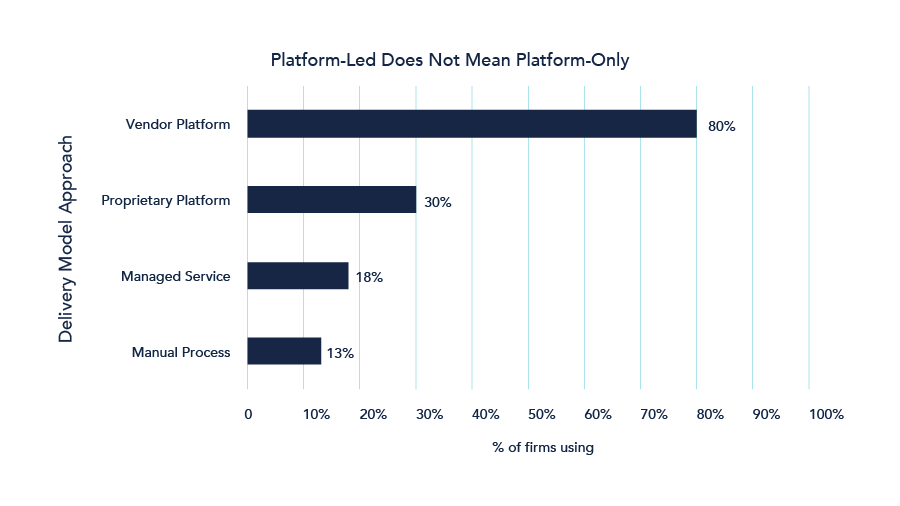
The findings suggest complexity increases with scale. Smaller firms tend to rely on pragmatic combinations of vendor platforms and manual processes, while larger organisations are more likely to layer strategic platforms, proprietary capabilities and outsourced services. As a result, few firms operate through a single data delivery model.
This fragmented landscape helps explain why data has become such a prominent transformation priority. Nearly half of firms identify data quality and accuracy as their biggest data and technology challenge, while four in ten cite legacy systems and technical debt. The challenge is not only collecting or storing data. It is creating a connected, governed and scalable data environment capable of supporting increasingly sophisticated business requirements.
What firms are changing
The transformation roadmap suggests firms are prioritising foundational change before attempting to scale more advanced capabilities.
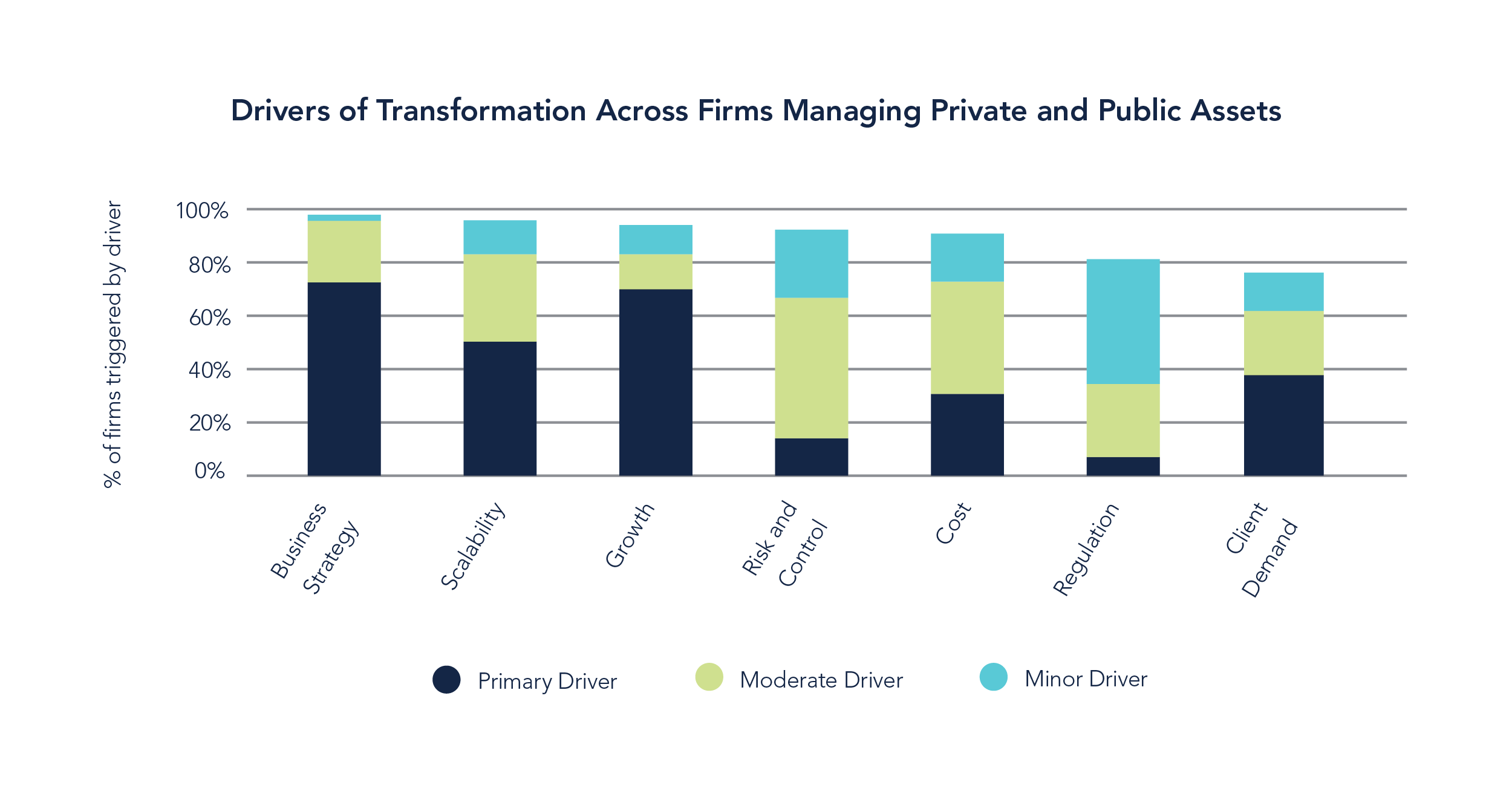
Data architecture has the highest level of planned activity across the three-year horizon, followed closely by data governance. Data analytics and data operations also feature prominently, indicating firms are pursuing improvements across the entire data lifecycle rather than focusing on isolated use cases.
The most common transformation initiative is data integration, followed by platform implementation and consolidation. Together, these themes point to an industry focused on simplifying fragmented operating models and creating more connected data environments.
The sequencing is particularly revealing. Activity in 2026 is concentrated around architecture, governance and operational foundations, while analytics and AI-related initiatives become increasingly visible across the broader roadmap. This suggests firms are taking a pragmatic approach to AI adoption, investing in the structures required to support advanced capabilities before seeking to scale them.
The survey also points to a broader operating model shift. Alongside integration and modernisation programmes, firms are pursuing platform consolidation, enhanced controls, outsourcing initiatives and organisational redesign. Open-text responses reference centralised data stores, supplier rationalisation, data connectors and AI-enabled efficiency, all pointing towards more integrated and scalable operating models.
How priorities differ by AUM
While the direction of travel is consistent, priorities vary by firm size.
- Smaller firms are primarily focused on practical modernisation and reducing operational inefficiencies through platform consolidation and data integration.
- Mid-market organisations display the broadest transformation agenda, balancing foundational modernisation with governance enhancements, AI deployment and operating model change.
- Global managers appear focused on rationalising complex data ecosystems, using integration and platform consolidation to simplify operations while creating the conditions for more scalable analytics and AI adoption.
Transformation priorities therefore appear to evolve with organisational complexity. As firms grow, the focus shifts from operational efficiency towards vendor rationalisation, governance and enterprise-scale enablement.
What is constraining data transformation?
Yet widespread ambition does not guarantee straightforward execution. Among firms planning data transformation, almost half report constraints are limiting their ambitions.
The most commonly cited barriers are resource and expertise shortages, closely followed by legacy technology and internal dependencies. Many organisations are therefore attempting to modernise data capabilities while simultaneously managing the complexity of existing platforms, competing priorities and interdependent systems.
The findings reinforce a broader theme emerging throughout the survey: technology alone is not enough. As firms invest in AI, automation and modern data platforms, the availability of specialist skills and transformation leadership is becoming a critical component of success.
Ready to Benchmark Your Transformation Journey?
Explore how your firm compares and uncover actionable insights tailored to your strategy.
Managing the Consequences of Growth
Why Complexity is Concentrated in the $100-500 Billion AUM Market
Firms managing between $100 billion and $500 billion in AUM occupy a distinctive position within the industry. They have achieved sufficient scale to support broader investment mandates, expand into new markets, and pursue more diverse growth strategies. Yet unlike the industry's largest institutions, they have not always developed the operational infrastructure required to absorb that complexity efficiently.
The survey findings suggest that this segment is increasingly managing the consequences of growth. Expansion across asset classes, products, distribution channels, and service-provider ecosystems is placing new demands on operating models, data capabilities, and operational controls. Transformation in this segment is therefore focused on ensuring operating models can accommodate greater complexity without sacrificing efficiency, control, or resilience.
Private Markets Are Accelerating Complexity
Private markets bring this tension into particularly sharp focus. Participation is now almost universal within this AUM segment, yet the way firms support those assets varies considerably. Alternative investments introduce distinct valuation, operational, governance, and data requirements that can be difficult to accommodate within pre-existing operating models, and the result is a more varied operating environment in which multiple delivery models, technologies, and operating practices often coexist within the same organisation.
Alternative investments are predominantly managed in-house, but approaches vary significantly by asset class. Two-thirds of firms investing in private market assets retain management internally for at least one asset class. Private credit and real estate show the strongest preference for internal management, while private equity and infrastructure display a broader mix of internal, delegated, and partially outsourced delivery models.
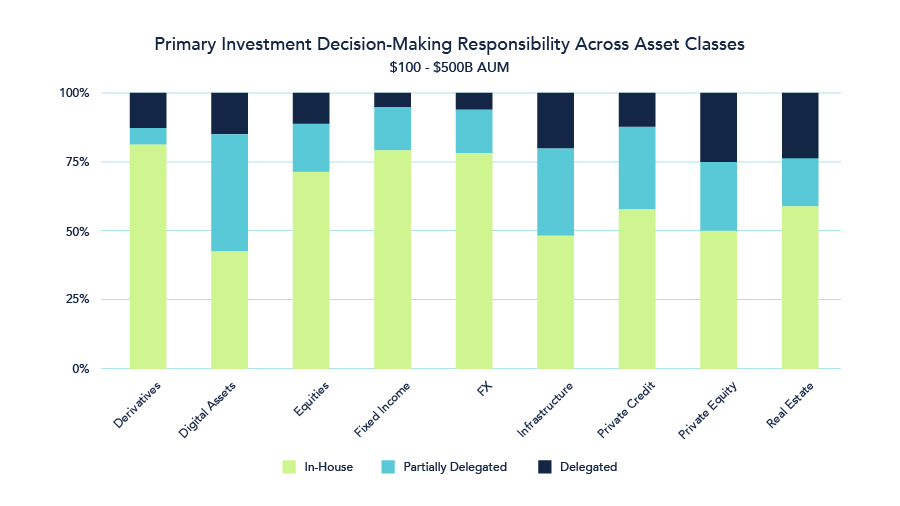
The variation is revealing. Rather than adopting a single management model across their private market activities, firms appear to be making targeted decisions about where to build internal capability and where to rely on external expertise. As a result, multiple management and delivery models frequently coexist within the same organisation.
Firms are broadening investment propositions, combining internal and delegated capabilities, and tailoring operating models by asset class. This flexibility can support growth and accelerate access to specialist capabilities, but it also increases demands on governance, oversight, and integration across the wider operating model.
How complexity is reshaping the transformation agenda
Every firm in this segment identifies data management and architecture transformation alongside system rationalisation among its priorities. More than half are simultaneously managing integration or consolidation with other entities, introducing an additional layer of organisational, operational, and technology dependency.
AI pursuits remain prominent, with 58% of firms identifying it as a priority. However, the findings suggest that AI is sitting alongside a much broader programme of operating model change rather than replacing more foundational initiatives. Data transformation, platform rationalisation, integration activity, and AI adoption are frequently progressing in parallel.
Rather than pursuing isolated initiatives, firms in this segment appear to be modernising foundations, integrating complexity, and introducing new capabilities simultaneously. While operational efficiency remains an important objective, firms are increasingly focused on building operating models capable of supporting a broader mix of asset classes, technologies, service providers, and investment strategies.
This is the only AUM segment to reference building toward adopting a Total Portfolio Approach as a top focus area, which further reinforces the theme of integration, with firms seeking to connect decision-making more effectively across public and private investments.
Where firms are investing to manage complexity
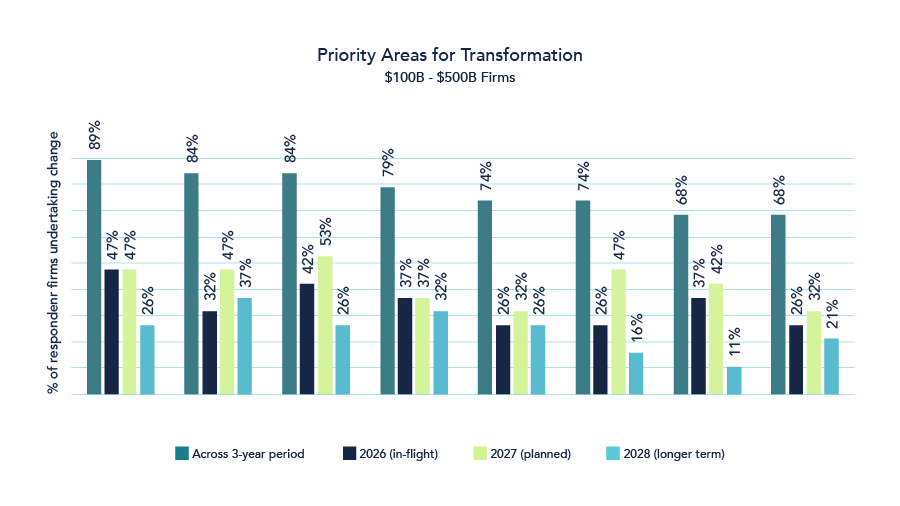
The survey highlights several areas where these pressures are becoming particularly visible.
Performance measurement and attribution
Three in four firms in this bracket are planning material changes to performance measurement and attribution over the next three years. Most programmes are expected to run for one year, with activity spread relatively evenly across the three-year horizon. Only one in seven programs extend across two years.
Data integration and modernisation is the most common form of change, selected by 57% of those transforming performance measurement and attribution functions, followed by platform implementation or consolidation, selected 42%. This reflects a current environment in which 63% of firms depend at least partly on third-party performance platforms. Among those firms, one in four supplements these systems with some combination of proprietary technology, outsourced services and manual spreadsheet reconciliation.
The transformation objective therefore appears to extend beyond replacing one tool with another. Firms are seeking stronger governance, greater visibility and improved operational resilience across a mixed technology and service landscape. Execution remains a concern, particularly for platform implementation and consolidation programs: 38% report challenges, primarily associated with legacy technology and internal dependencies. More broadly, outside of platform implementations, budgetary constraints are the most common factor behind project de-prioritisation today.
Post-trade operations
Three in four firms expect to make changes to post-trade operations over the next three years. Operational resilience emerges as the primary driver of change, cited by 64% of firms undertaking post-trade transformation, while 42% are also focused on improving efficiency and controlling costs.
More than half of firms are prioritising control and oversight enhancements, reflecting growing demands around governance, risk management, and operational resilience. These initiatives are typically short-term in nature, with most expected to be delivered within a single year, suggesting firms are targeting specific control gaps and strengthening operational resilience than pursuing large-scale operating model redesign.
Data integration and modernisation is the second most common area of focus. As firms introduce new asset classes, products, and service-provider relationships, operational data is becoming a critical control mechanism. Firms increasingly require a connected view of activities, exceptions, and exposures across the post-trade lifecycle to support oversight and reporting.
The findings reinforce that firms are seeking to scale without sacrificing control. As operating environments have become more complex through asset class expansion, transformation is increasingly focused on improving visibility, resilience, and operational discipline.
Where outsourcing transitions are anticipated, delivery challenges appear most closely linked to legacy technology constraints and evolving requirements.
Outsourcing transitions require rigorous transition planning, dependency management, and a clear approach to operational continuity. Successful outcomes depend as much on managing technology, data, and process dependencies as they do on the outsourcing strategy itself.
Portfolio management transformation
Portfolio management perhaps best illustrates the convergence of growth and transformation priorities. Programmes are supporting asset class expansion and broader growth objectives, with AI deployment and platform implementation often progressing alongside one another. A quarter of the firms undertaking change are combining both initiatives, while 30% programmes are expected to continue across multiple years.
Building operating models that can support growth
Taken together, these findings suggest that complexity is increasingly shaping where firms focus transformation investment. Whether the objective is improving performance measurement, strengthening post-trade controls, or modernising portfolio management capabilities, the underlying challenge is similar: supporting a broader range of investment activities while maintaining integration, visibility, and operational control.
Rather than addressing individual capabilities in isolation, firms appear focused on strengthening the links between investment decision-making, technology platforms, and supporting data capabilities. As investment mandates become broader and operating models more interconnected, firms are investing in the data, governance, platforms, and control mechanisms needed to manage complexity at scale.
This is what makes the $100-500 billion segment appear to be such a significant inflection point. These firms have outgrown the relative simplicity of smaller managers but have not yet achieved the scale advantages of the largest institutions. For these firms, transformation is becoming the mechanism through which investment ambition is converted into scalable capability. The opportunity is growth. The challenge is ensuring that the operating model can keep pace.
Delivery Reality
Turning Transformation Ambition into Outcomes
The survey data shows an industry that is not struggling to identify transformation priorities. From investment research in the front office, to performance measurement, post-trade operations, and data, there is broad alignment on where investment is required. However, transformation objectives do not immediately translate to delivery, and there is often a long road ahead for those treading its path. Firms are attempting to deliver multiple interdependent programmes simultaneously while navigating legacy technology, competing priorities, and constrained specialist capacity.
Delivery is widespread, but progress is uneven
Nearly 6 in 10 firms report a delay affecting at least one programme on their transformation roadmap
While transformation activity is progressing across much of the operating model, delivery outcomes vary considerably. Many firms report programmes advancing as planned, yet delays and deprioritisation remain common across areas requiring significant technology, data, and operating model change.
The challenge is the ability to execute multiple programmes concurrently while managing the dependencies that exist between them. As transformation agendas broaden, successful delivery increasingly depends on how effectively firms can sequence change, allocate resources, and coordinate stakeholders across the organisation.Delivery challenges are not.
Delivery outcomes across the operating model
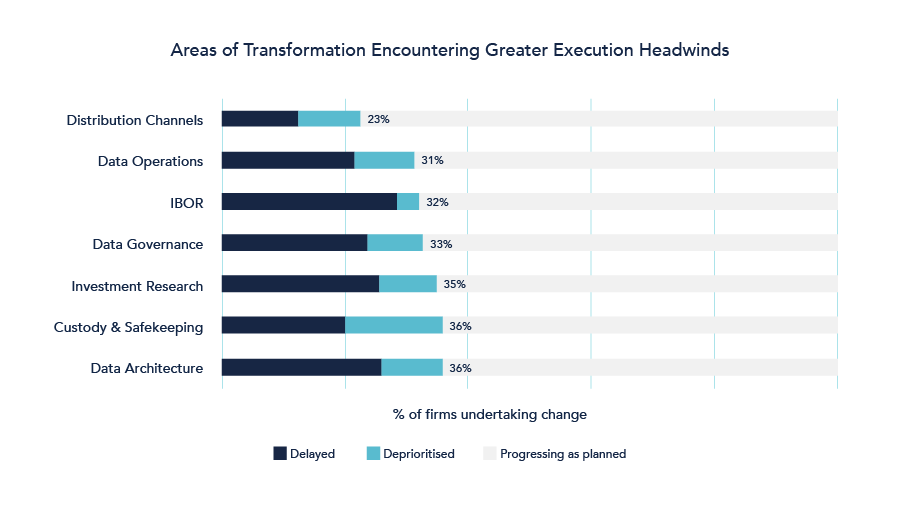
The challenge is not a lack of progress, but an uneven ability to execute complex change. Many respondents can point to a subset of transformation projects within specific areas that are advancing as planned, yet initiatives requiring significant technology, data or operating model change continue to encounter higher levels of delay and reprioritisation.
Where Delivery Pressure is Concentrated
Snapshot: AI deployment
-
44% of firms report that at least one AI-related initiative has been delayed
-
Almost one-third have deprioritised at least one AI-related initiative
AI is frequently being deployed as part of wider change spanning investment processes, data platforms, analytics capabilities and operating model redesign. Its delivery therefore depends on more than the technology itself.
Primary Pressure: Readiness of the Underlying Environment
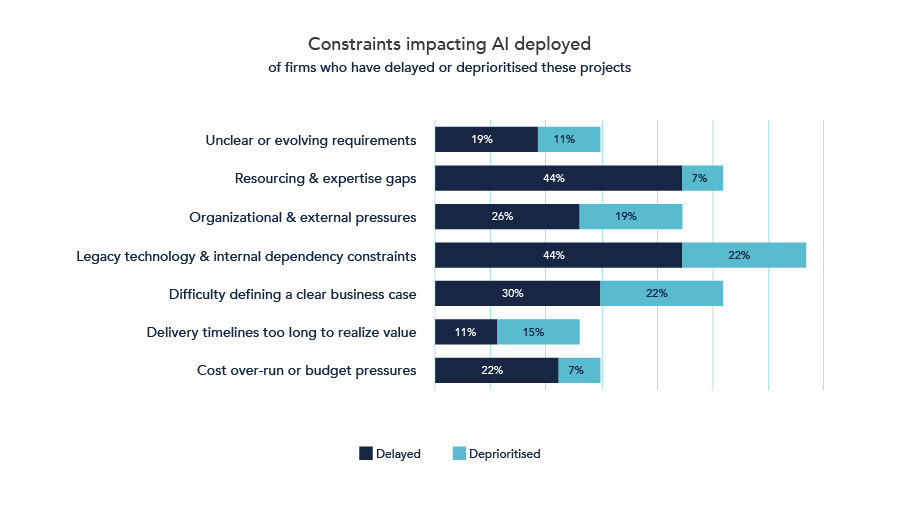
More than half of delayed AI initiatives cite legacy technology or internal dependencies as a contributing factory. The data suggests that AI programmes are exposing weaknesses in the environments into which they are being introduced as these initiatives will not be operating in isolation. They will require firms to address questions of governance, data ownership, workflow design and implementation sequencing alongside the technology deployment itself. As firms progress towards deployment, many are encountering the practical limits of fragmented data environments, legacy architectures, and disconnected operating models.
Snapshot: Platform Implementation
More than a third of relevant platform implementation and consolidation initiatives have been delayed or deprioritised. Platform transformations require firms to align operating models, governance structures, business processes and technology decisions simultaneously. This creates a broader set of delivery pressures, from legacy dependencies and resource constraints to competing priorities and evolving requirements. The findings suggest that the platform programmes that are progressing as planned are often distinguished by the ability of the firm to coordinate change across functions, stakeholders and interconnected initiatives.
Delivery challenges are less a function of the technology being implemented and more a reflection of project complexity. Whether firms are deploying AI, modernising IBOR capabilities, or consolidating core investment and operational systems, success depends on managing interdependent technology, data, governance, and operating model change. Organisations that can coordinate these moving parts effectively are more likely to deliver programmes on time and realise value sooner.
Three transformation delivery observations
- Existing complexity continues to shape delivery
- Expertise and capacity is a differentiator
- Time-to-value is influencing prioritisation
1. Existing complexity continues to shape delivery
Transformation timelines remain closely tied to the systems, architectures and internal dependencies already in place.. The survey findings consistently point to legacy technology and internal dependencies as leading causes of delay across major transformation programmes.
This is perhaps unsurprising. Core investment platforms such as OMS, IBOR and ABOR environments rarely operate in isolation. Many have evolved over years, accumulating integrations, operational workarounds, and dependencies across the wider operating model. As a result, transformation programmes often involve far more than implementing a new solution. They require firms to carefully unwind existing processes, data flows, controls and integrations without disrupting day-to-day operations.
The longer organisations wait to modernise critical platforms, the more complex transformation becomes. Existing complexity does not simply coexist with change programmes; it actively shapes their scope, sequencing, risk profile and delivery timelines.
2. Expertise and capacity is a differentiator
Specialist skills, experienced programme leadership and domain knowledge are increasingly important where internal capacity is stretched.
Many organisations are attempting to deliver multiple transformation initiatives simultaneously while maintaining day-to-day operations. In this environment, delivery challenges are often less a function of strategy than execution capacity. Even well-funded programmes can struggle when key business stakeholders, subject matter experts and decision-makers are spread too thinly across competing priorities.
The survey findings reinforce a reality frequently observed across the industry: successful programmes depend on having the right expertise applied at the right time. Programme governance and reporting remain important, but transformation outcomes are often determined by the availability of practitioners with deep operational, data and technology knowledge who can navigate complex decisions, manage dependencies and maintain momentum through delivery.
3. Time-to-value is influencing prioritisation
Initiatives without a clear route to near- or medium-term value appear more exposed to deferral as budgets and resources compete.
As transformation portfolios expand, firms are becoming increasingly selective about where they focus investment. Programmes that support efficiency, resilience, operating model simplification or strategic growth objectives often receive continued sponsorship, while initiatives with less clearly defined business outcomes face greater scrutiny.
The challenge is not a lack of ambition. Rather, firms are balancing an extensive transformation agenda against finite budgets, capacity and delivery capability. In this environment, demonstrating value early, maintaining stakeholder alignment and establishing a credible path from implementation to business benefit are becoming increasingly important factors in securing programme momentum.
The importance of execution capability
The industry's transformation challenge will always be one of execution Most firms have identified their priorities, whether that is AI adoption, data transformation, platform rationalisation, operating model simplification, or private market expansion. The differentiator is the ability to deliver them. As transformation portfolios become broader and more interconnected, success depends on navigating dependencies, sequencing change effectively, and maintaining momentum across multiple initiatives.
Legacy platforms, competing priorities, resource limitations and growing operational complexity all influence delivery outcomes. In this environment, expertise in programme leadership, operating model design and implementation is becoming just as important as the technologies being deployed. Firms that combine a clear transformation agenda with strong execution capability will be best positioned to convert strategy into measurable business outcomes.
Where is delivery pressure building in your roadmap?
Compare your transformation priorities, constraints and delivery progress with firms of a similar size and operating profile. Speak with Citisoft’s team to identify where legacy dependencies, capability gaps or programme complexity may be putting outcomes at risk.
From Design to Delivery
We're Your Partner at Every Step
Citisoft provides senior executives and key stakeholders with the ability to turn transformation ambition into delivery. We partner with our clients to solve today’s complex challenges and make informed decisions that enable tomorrow’s opportunities.
Whether firms are modernising core platforms, rationalising technology landscapes, transforming data capabilities or supporting growth into new asset classes and markets, successful outcomes depend on balancing strategic objectives with practical execution. Our consultants bring deep industry knowledge and real-world delivery experience, helping clients navigate complexity, reduce programme risk and realise value faster.
From strategy and roadmap development through to implementation and optimisation, we enable firms to build the capabilities, operating models and delivery frameworks needed to support long-term growth, scalability and operational resilience.

We have the expertise and track record to design and deliver projects of any scope.
Discuss your needs with an expert and discover how we can help.
Submit an inquirySurvey Methodology
The 2026 Transformation Survey was designed to capture a point-in-time view of operational maturity, strategic priorities, and transformation roadmaps across the investment management industry. The survey focused on both current-state operations and forward-looking change agendas, with a particular emphasis on investment operations, data management, and technology enablement.
Survey Design
The question set was developed in collaboration with domain experts across Citisoft’s global practice areas. It includes a mix of multiple-choice, Likert-scale, and free-text questions, structured to allow both quantitative benchmarking and qualitative insight. The survey was refined from previous years to improve clarity and expand coverage of emerging topics (e.g., AI, digital assets).
Participants
Respondents included senior leaders and decision-makers from 66 asset managers, asset owners, insurers, sovereign wealth funds, and other institutional investment entities. Participation was by invitation, targeting firms across North America, EMEA, and APAC to build a representative industry sample.
Data Collection
The survey was conducted digitally between 15 June and 6 August 2026, with responses anonymised to encourage candour and protect firm-level confidentiality.
Limitations
While the survey captures a broad cross-section of the industry, findings should be interpreted as directional rather than exhaustive. Some questions allowed for multiple selections or free-text input, which may introduce variability in interpretation.