





2025 Transformation Agenda: Operational Foundations for Growth

Citisoft’s 2025 Transformation Survey gathered insights from nearly 70 asset managers, asset owners, and insurers. The survey was designed to offer a unique statistical perspective to enable firms to benchmark their own transformation agenda.
Don’t have time to read this? Take it with you!
Download PDF
Executive Summary
The 2025 Transformation Survey reveals an industry in motion. The data reflects a robust cross-section of the industry, from global giants to agile mid-sized players, each offering unique insights into the pressures and priorities shaping transformation. Though some themes span firm types and sizes, the greatest insight is often found by looking at cohorts based on AUM, perhaps the defining metric for alignment on change agendas.
Three themes dominate this year’s findings. First, data architecture is at the heart of transformation. Nearly 90% of firms plan to overhaul their data operations and governance by 2027, recognizing that clean, governed, and integrated data is essential for agility and intelligence. AI adoption is accelerating, with 88% of firms deploying or piloting capabilities with success hinging on data maturity.
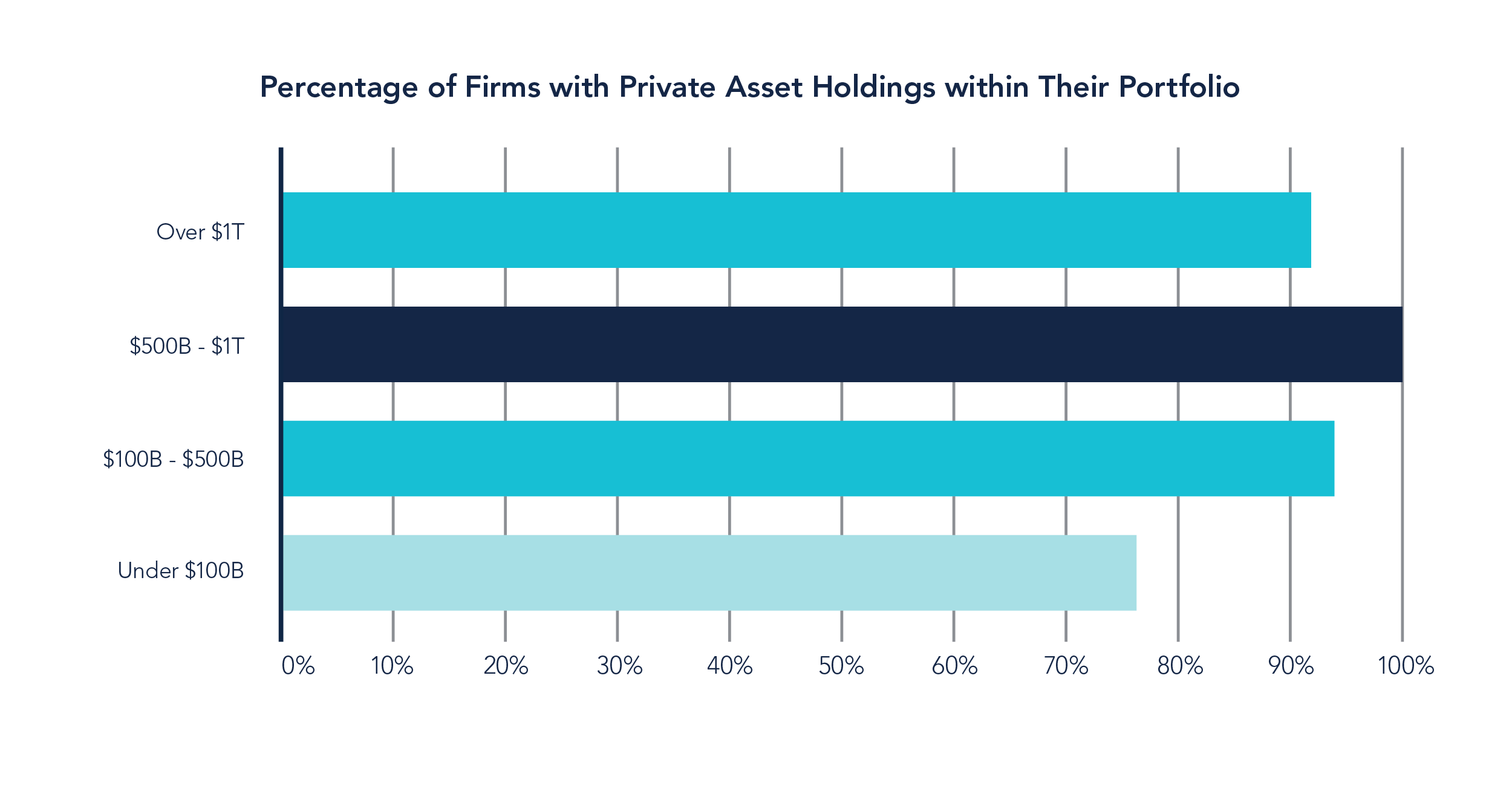
Second, private markets are reshaping operating models. Over 90% of firms with more than $100B AUM now manage private assets, driving demand for unified oversight. Capturing the previously elusive total portfolio view has emerged as an urgent priority, with the asset management and the vendor community working together to adopt solutions that better reflect the complexity of an increasingly diversified asset mix.
Third, smaller firms are ambitious but constrained. Those under $100B AUM, who make up 43% of the sample, are pursuing transformation across data, risk, and performance, but face structural blockers; fragmented systems, spreadsheet reliance, and limited internal expertise are slowing execution.
The crux of successful transformation lies in expertise. Firms that engage SMEs and domain specialists are better equipped to define scope, navigate complexity, and execute change. These experts bring the clarity, precision, and experience needed to translate ambition into action—especially in environments where internal capacity is stretched. Crucially, it’s the right people making a key difference at the right time that enables transformation to move from intent to impact.
The message is clear: transformation is underway, but execution is uneven. Firms that resolve structural friction early will scale faster, deploy smarter, and lead the next wave of innovation.

Where the Industry Stands Today
Though third-party systems dominate across the industry’s operating models, portfolio management is one area where proprietary solutions persist, especially amongst the largest firms.
This section offers a comprehensive snapshot of where the industry stands today. By examining operational footprints, asset class strategies, and technology ecosystems, we establish a baseline for understanding the transformation journeys ahead. These insights reveal the diversity of operating models, regional presence, and the maturity of data integration across the front-to-back office.
Asset Class Management
Traditional asset classes—equities, fixed income, FX, and derivatives—remain the backbone of portfolio construction , with most firms continuing to manage these in-house. This reflects a strong preference for retaining control over core investment activities.
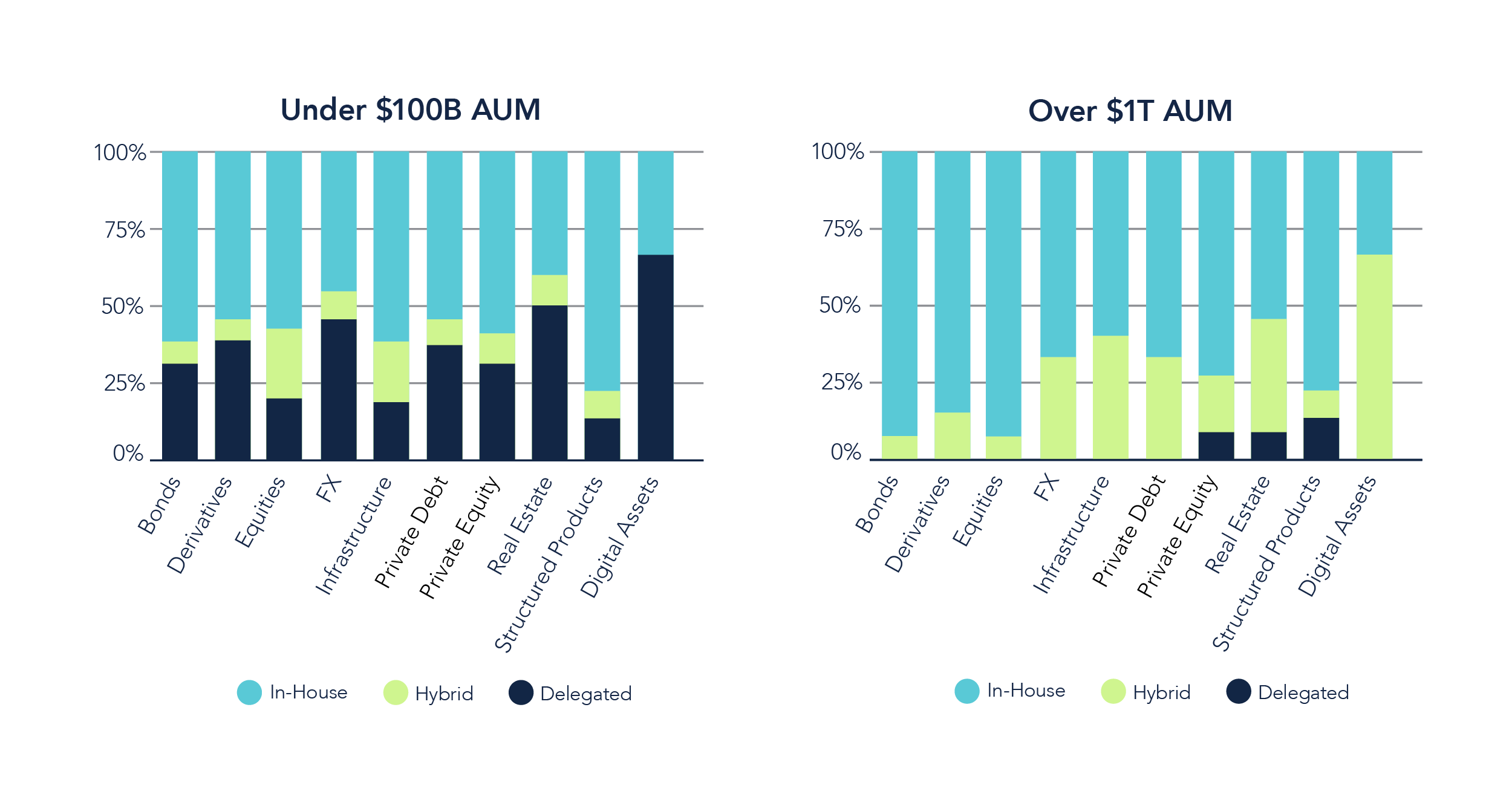
However, the landscape is shifting. Private markets have moved firmly into the mainstream, with 81% of firms managing private assets such as private credit, private equity, real estate, and infrastructure. These asset classes are predominantly managed in-house, signaling growing internal capability and a strategic prioritization of alternatives as key drivers of future growth.
Digital assets, meanwhile, are gaining traction. While still emerging, 16% of firms are actively exploring this space, with portfolio management models varying by scale. Smaller firms (under $500B) tend to delegate management of more esoteric products (e.g. private markets, digital assets), while larger institutions are building hybrid or fully internal capabilities. This suggests that scale enables internal capability-building, while smaller players rely on external expertise to access this emerging asset class.
Operating Models
Modern operating models are increasingly defined by system interoperability and cloud-accessible data platforms; technologies that enable scalable, governed, and auditable environments.
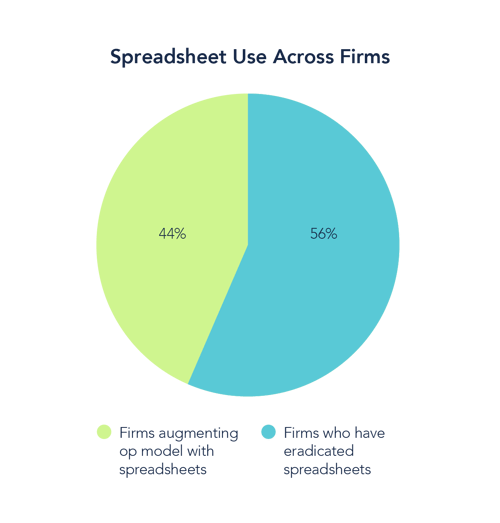
These platforms are replacing legacy processes and manual workarounds, marking a meaningful shift in how firms manage their day-to-day operations. While 44% of firms have fully eradicated spreadsheets from their model, their continued use, particularly in firms with under $100B AUM, signals that the transition is still underway. In these contexts, spreadsheets often supplement third-party platforms, especially in data governance and data operations.
This isn’t just a story of system adoption; it’s about building confidence, integration maturity, and data transparency. Spreadsheets aren’t inherently problematic, but when they underpin mission-critical analytics, they introduce risk and inefficiency. For many, they remain part of the bridge toward more progressive, interoperable operating models.
Editor’s Note: Throughout this report, “third-party systems” and variations including software vendor or service provider solutions are used interchangeably to refer to all software solutions that are developed, ‘packaged’, and sold to asset managers and owners by external organizations.
Across the industry, third-party systems now dominate operational models—particularly in portfolio management, trade execution, client reporting, and compliance/risk, where adoption exceeds 50% in all segments. These platforms have become the default infrastructure for core investment functions, replacing proprietary systems in most cases.
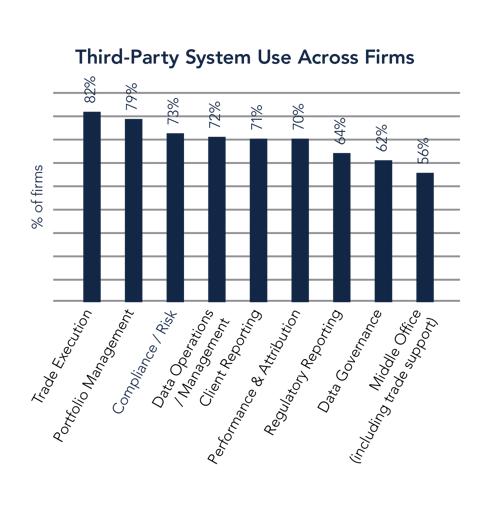 Proprietary systems continue to play a pivotal role in portfolio management, particularly among firms with over $1T AUM, where 38% rely on internally developed platforms. This is one of the highest proprietary usage rates across all surveyed functions and segments, suggesting that portfolio management remains a domain where firms prioritize bespoke capabilities over standardized vendor solutions. Despite third-party adoption rates reaching 78% or higher in most AUM segments, vendors have struggled to displace proprietary systems in portfolio management. The data indicates that firms view proprietary platforms as essential to maintaining differentiation in investment strategy execution—areas where off-the-shelf solutions may lack the required nuance or flexibility.
This resistance to vendor-led standardization in portfolio management stands in contrast to other operational areas, such as data governance and data operations, where third-party platforms have gained stronger traction. In these functions, external vendor usage is strong across firms of all sizes. However, the continued reliance on spreadsheets, especially among smaller firms, suggests that adoption alone doesn’t guarantee integration or confidence. Instead, spreadsheets often serve as a stopgap, supplementing third-party platforms in areas like data validation, reconciliation, and governance workflows.
The middle office* presents a more complex picture. Among firms under $1T AUM, 77% use third-party systems, but half of those also oversee outsourced models, creating hybrid environments. Smaller firms show an even split: 40% outsource, 40% use third-party systems, and a minority adopt both. While the trend is clearly away from proprietary systems, a small proportion still rely on them, often in combination with third-party platforms (56%) or spreadsheets.
This blend of third-party, outsourced, and proprietary models reflects a balancing act: firms are actively navigating cost, control, and capability. A fully outsourced or fully proprietary model is increasingly rare; instead, firms are designing operating models that strategically combine all three. When thoughtfully orchestrated, this mix allows for flexibility, resilience, and fit-for-purpose functionality across different parts of the business. The goal isn’t uniformity. Its interoperability, where each component plays a role in a cohesive, scalable ecosystem.
*Here, middle office refers to the response option “Middle Office (including trade support)”. Though definitions of the middle office often include risk and compliance, data management and governance, client and regulatory reporting, and performance measurement, this question split out these activities to provide a more granular view. The x-axis labels in “Third-Party System Use Across Firms” reflect verbatim language in the survey.
Strategic Priorities and Transformation Drivers
88% percent of firms are actively deploying or exploring applications of AI. The value derived, however, will depend on the underlying data architecture, governance, and integration.
This year’s survey reveals a confident and forward-looking industry. Firms are no longer solely reacting to regulatory pressure or cost constraints; they are investing in the means to growth, innovation, and operational modernization. The data shows a clear pivot toward foundational change, with transformation efforts concentrated in areas that enable scale, agility, and enterprise-wide visibility.
Size Matters: Differentiated Drivers Across AUM Bands
Transformation drivers vary significantly by firm size. Firms over $1T AUM are focused on scalability, building infrastructure that can support global operations and diversified portfolios. Those in the $500B–$1T range emphasize business strategy, aligning transformation with long-term growth and client outcomes. Mid-sized firms ($100B–$500B) are driven by client demand and product innovation. For firms under $100B AUM, transformation pressures are more acute. These firms are ambitious but constrained—held back by legacy systems, limited internal expertise, and structural blockers.
Data Enhancement
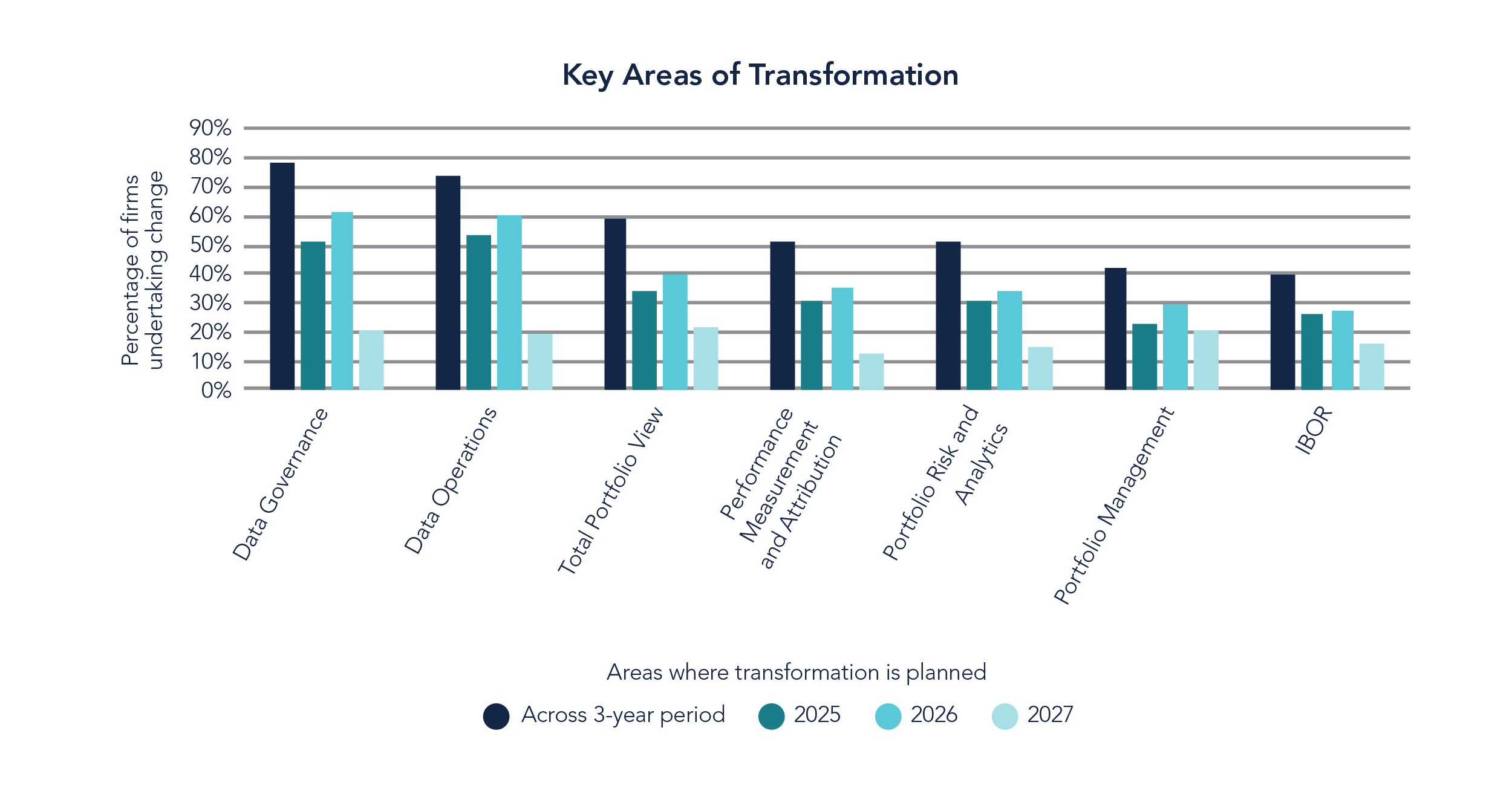
Across the board, firms are actively advancing their data architecture, with nearly 90% of firms planning to overhaul their data-related functions within three years. This work is enabling firms to modernize their data operating models—supporting AI adoption, system interoperability, and scalable analytics environments. The direction of travel is clear. The industry is moving toward more intelligent, automated systems that reduce manual effort and unlock deeper insight.
AI-readiness is a clear area of momentum, with 88% of firms actively deploying or piloting capabilities. But successful implementation depends on the strength of the underlying data infrastructure. Architecture, governance, and integration must work in concert to ensure data is usable, trusted, and accessible across platforms.
Data governance, in particular, remains a priority—but its track record is mixed. Despite being a fixture in transformation roadmaps, many initiatives struggle to gain traction due to fragmented tooling, unclear ownership, or lack of sustained investment. The firms making real progress are those embedding governance into broader architectural strategy, rather than treating it as a standalone fix.
Private Markets and the Push for Unified Oversight
The growth of private markets is reshaping strategic priorities. As allocations to private credit, private equity, real estate, and infrastructure grow, so too does the desire for a consolidated view of risk that can be used as the basis for comprehensive, strategic decision making.
Accordingly, nearly three-quarters of all firms are actively enhancing capabilities to support a total portfolio view (TPV), and 59% have planned projects over the next three years to enable unified oversight across assets. Performance measurement is undergoing similar scrutiny, with over half of firms transforming systems to reflect the distinct needs of books including both public and private assets. These priorities are not just operational. They are strategic responses to the complexity of private markets, where manual processes and siloed systems hinder transparency and control.
Data Integration and AI
By 2027, nearly 90% of firms will have transformed their data governance or data operations—those who haven’t may already be behind.
Data architecture has emerged as a strategic priority across operating model transformations. At the heart of this shift is a clear business requirement: firms need high-quality, timely data to drive decision-making, meet client expectations, and support scalable operations. Crucially, this is only achievable with the aid of sound data governance. Without it, even the most advanced architecture struggles to deliver meaningful outcomes.
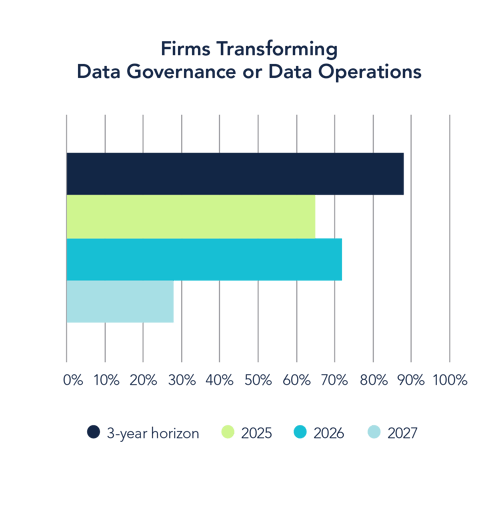
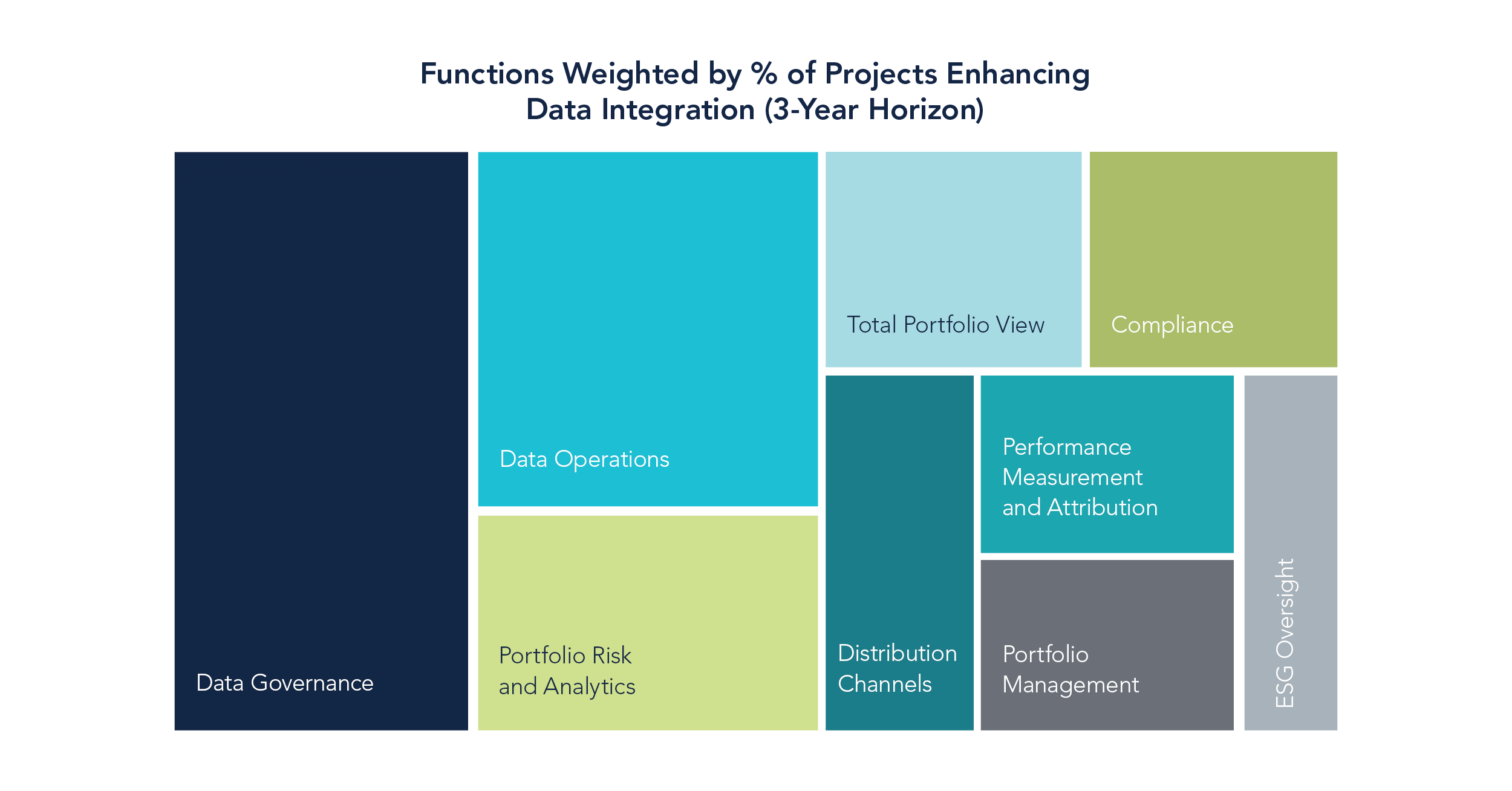
Firms are no longer treating data as a back-office hygiene function, they’re investing in comprehensive architecture redesigns to enable scale, agility, and intelligence. Nearly 90% of firms plan to overhaul their data-related functions within three years, signaling a want for more integrated, future-ready operating models.
In 2025, enhanced data integration is also the most common transformation across all AUM bands. But by 2026–27, the picture becomes more layered. Mid-sized firms ($100–$500B AUM) are pairing integration with system deployment, while larger firms are increasingly restructuring resources alongside integration efforts. Even among firms under $100B AUM, integration remains the dominant theme supported by a desire to replace legacy solutions.
These efforts span multiple dimensions: data operations, analytics, and governance all feed into the broader architecture transformation. While governance remains a critical enabler, it is rarely pursued in isolation. Instead, it’s embedded within comprehensive data programs that aim to connect, govern, and mobilize data across the enterprise.
AI Ambition Depends on Data Maturity
AI is now embedded in nearly every transformation agenda, with 88% of firms planning to deploy or pilot capabilities. But the story beneath that figure is more telling: firms have realized that AI cannot scale without clean, governed, and integrated data. Data governance and operations are not just adjacent to AI, they’re prerequisites.
Smaller firms are exploring how to use AI to automate manual processes and reduce spreadsheet reliance. Mid-sized firms are approaching how to embed AI into broader architecture strategies. Larger firms are combining AI with large language models to enhance platforms and optimize strategies. Across all segments, the success of these efforts hinges on the quality and accessibility of underlying data.
Structural Friction Is Slowing Execution
This is precisely where ambition meets resistance. Despite reporting moderate to high levels of front-to-back data integration, firms continue to cite integration as one of the most persistent challenges, revealing a maturity paradox: the more advanced a firm becomes, the more complex its integration demands. As firms scale, they must align governance, interoperability, and scalability across increasingly diverse systems and asset classes.
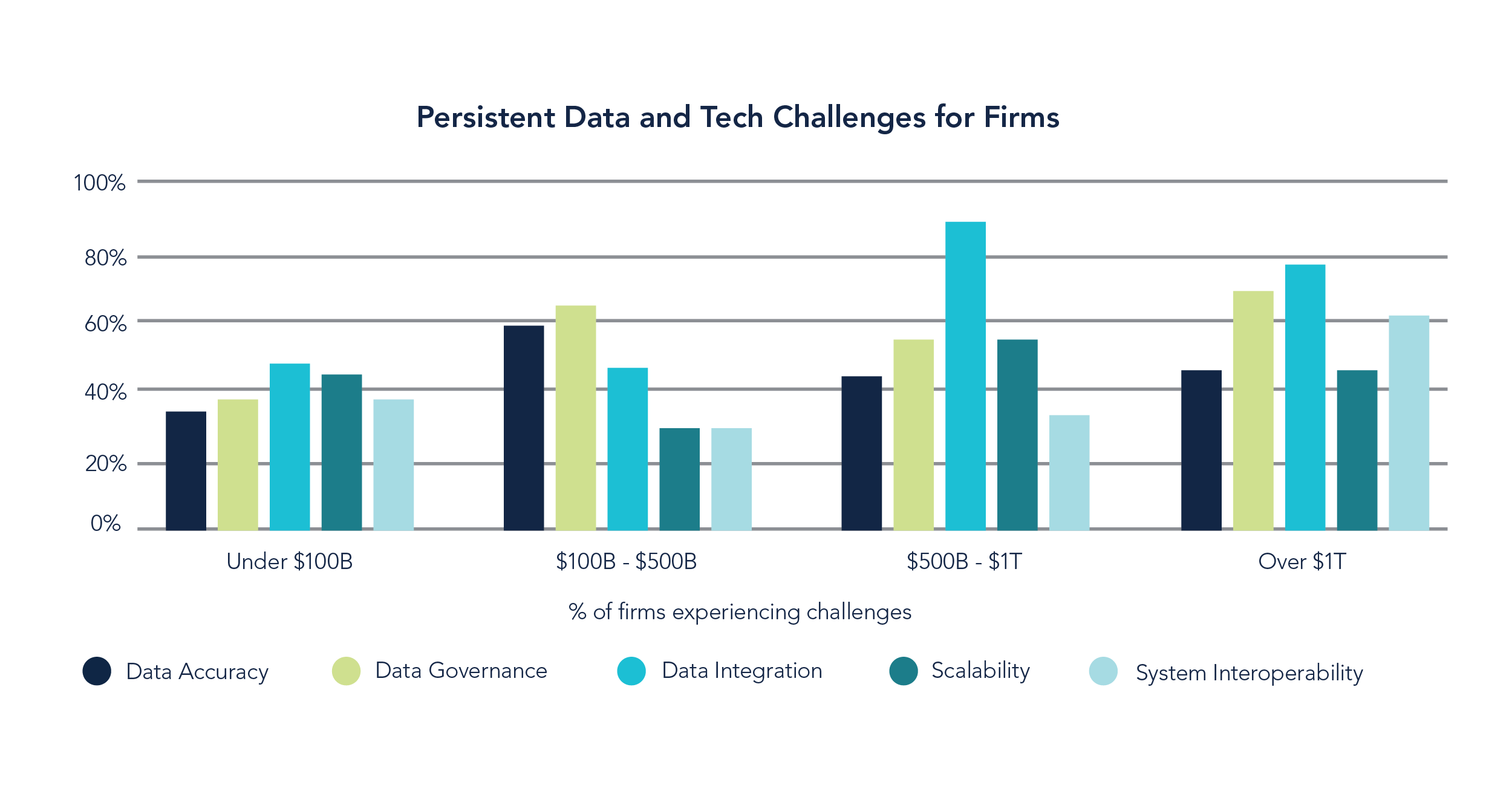
Larger firms show inconsistent integration scores, hindered by interoperability issues across sprawling infrastructures—with 77% of firms over $1T AUM reporting integration as a persistent challenge. These challenges are not just operational; they have real consequences. Firms with low integration scores report longer deployment timelines for data initiatives, potentially delaying the capabilities they aim to scale.
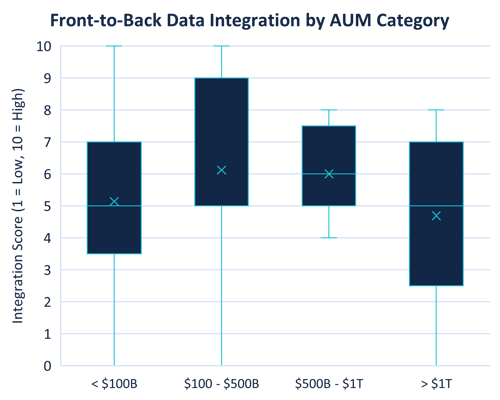 The $100–$500B AUM segment demonstrates strong integration maturity, but still grapples with governance and data accuracy as persistent challenges.
Meanwhile, spreadsheet reliance remains high among firms under $100B AUM, where up to 40% augment the use of vendor solutions with manual tools. This reliance reflects lower integration maturity and contributes to execution delays.
Integration isn’t the end of the story. While it is a critical milestone, it doesn’t guarantee data quality, adaptability, or execution speed. As firms mature, integration demands become more complex, without resolving structural blockers like system dependencies, resource constraints, and weak business cases, transformation timelines will stretch. To scale faster and deploy smarter, firms must move beyond integration to build data architectures that are resilient, interoperable, and ready to evolve with the business.
Delivering Value through Your Data Operating Model
A robust data strategy is the cornerstone of extracting value from your organization’s data. But its success goes beyond just having a strategy—it’s about aligning it with your business goals and pairing it with an effective data operating model. Together, these elements form the foundation for impactful, business-driven data initiatives.
Private Markets, TPV, and Performance Measurement
Seeking a better foundation for strategic decision making, 80% of firms managing private assets are focusing transformation efforts on a total portfolio view in the next 24 months.
Private markets—encompassing private credit, private equity, real estate, and infrastructure—have become a cornerstone of diversification and growth strategies. Over 90% of firms with more than $100B AUM now manage private assets, with consistent exposure across all four asset classes. This growth is driven by the search for alpha, portfolio diversification, and resilience during economic downturns.
However, the integration of private assets into broader investment operations presents unique challenges. Unlike public markets, private assets are not marked to market daily, often rely on manual processes, and are managed in siloed environments. These characteristics complicate efforts to achieve a unified view of portfolio performance and risk.
A Preference for In-House Portfolio Management
The survey reveals a dominant trend: in-house management of private assets. Nearly 65% of firms manage their alternative investments at least partially in-house, while 18% fully delegate the management of their private assets—exclusively among firms with under $500B in AUM. The rest adopt a tailored mix of delegated, hybrid, and in-house models. This trend of internalization reflects a desire for control but also exposes operational inefficiencies. To that end, if we look at broader operating models, firms managing privates are 20% more likely to use spreadsheets for portfolio management and valuations compared to their peers.
Drivers of Transformation
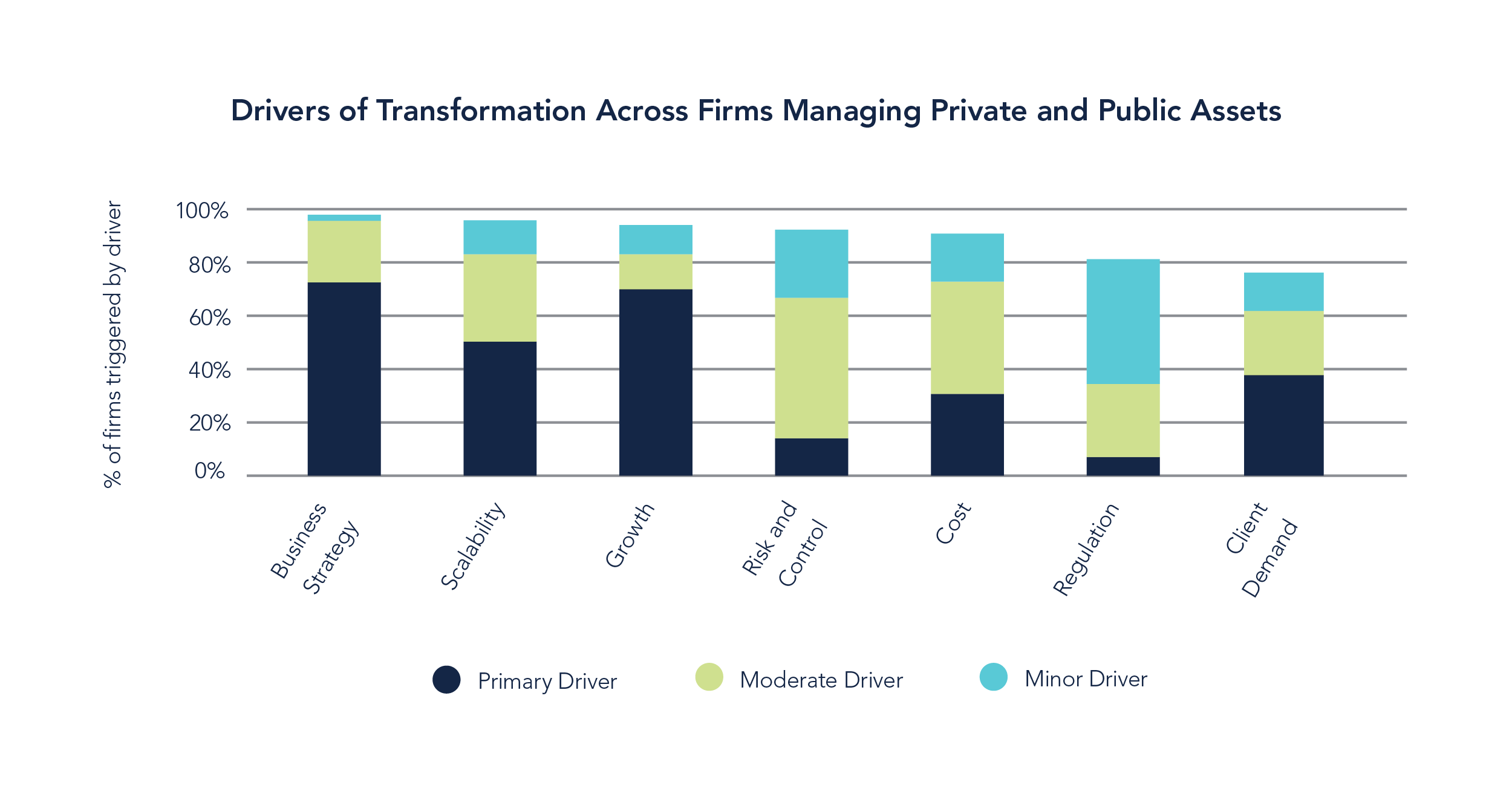
The expansion into private markets is not just a tactical shift, it marks a fundamental reorientation of business strategy across the investment management industry. Firms are no longer dabbling in alternatives; they are committing to them as a core part of their growth agenda. This strategic pivot is reshaping operating models, demanding new capabilities in data, systems, and governance.
Private markets offer what traditional asset classes increasingly struggle to deliver: differentiated returns, lower volatility, and portfolio resilience. As firms chase these benefits, they are forced to confront the operational realities of managing complex, illiquid assets. Growth ambitions are driving transformation, but they are also exposing gaps in scalability, integration, and control.
Scalability has emerged as a critical concern. As allocations to private assets grow, so too does the need for systems and processes that can handle the volume and complexity. Risk and control considerations are also rising to the fore, particularly as firms grapple with the cost and effort of upgrading legacy infrastructure.
Transformation in Focus: Total Portfolio View and Performance Measurement
As firms expand their exposure to private markets, the pressure to modernize core investment infrastructure is intensifying. Legacy systems—often designed around public assets—struggle to accommodate the complexity, frequency, and data demands of private holdings. This has made total portfolio view (TPV) and performance measurement two of the most urgent areas for transformation.
Building a Unified Lens with a Total Portfolio View
The challenge is not just technical; it’s strategic. Without a unified view across public and private assets, firms risk fragmented reporting, inconsistent performance attribution, and limited insight into portfolio-level risk. Many are now prioritizing TPV as a foundation for better decision-making, with 78% of firms managing private assets planning improvements in this area over the next 24 months.
These changes are driving a wave of system upgrades and replacements. Firms are moving away from legacy platforms in favor of more integrated, scalable solutions; ones that can support automation, reduce manual touchpoints, and deliver accurate, timely data.
Performance Measurement: A Parallel Priority
Performance measurement is receiving similar attention, especially for firms managing multi-asset portfolios. Of all the firms surveyed, 51% are actively transforming their performance architecture over the next three years—9-in-10 of those transforming performance are also managing multi-asset portfolios, where complexity and data fragmentation are especially acute.
In 2025, 72% of these firms are replacing legacy systems, with transformation efforts shifting toward enhanced data integration (45%) and new system deployment (40%) in 2026. The primary drivers? Operational resiliency and cost control—two imperatives that are reshaping how firms think about performance measurement and attribution infrastructure.
Interestingly, outsourcing remains a limited part of the solution. Despite the complexity of managing multi-asset, only a handful of firms are considering external providers for these functions, reflecting a broader preference for maintaining oversight, agility, and alignment with internal investment processes.
Yet transformation is not without friction. Among firms due to begin performance measurement projects, 1-in-5 cite primary blockers such as difficulties in sizing the problem and defining a compelling business case and available solutions that are too expensive compared to the scale of their needs.
Ready to Benchmark Your Transformation Journey?
Explore how your firm compares and uncover actionable insights tailored to your strategy.
Lean but Driven: How Smaller Asset Managers Are Rebuilding for Growth
Recognizing the foundational role of data when pursuing growth, 93% of firms
with under $100B in AUM are refining data architecture over the next three years.
Ambition Meets Constraint
The sample of firms under $100B AUM are actively transforming to support growth. They’re launching new funds, expanding into wealth management, and investing in ETFs and alternatives to meet shifting client demand, but they’re doing so under uniquely demanding conditions.
Their ambitions are clear:
- Enhance data architecture across all functions
- Explore AI applications
- Build a total portfolio view
Yet they’re navigating growing asset complexity and evolving client expectations, all while operating with leaner resources and more fragmented systems than their larger peers. For many, AI exploration spans both basic generative use cases and more advanced applications. For firms with both public and private assets, the push for a total portfolio view reflects a desire to base strategic decision making on a single, comprehensive view of risk and analytics.
Technology as a Growth Enabler
Delivering on these ambitions requires more than strategic intent, it demands scalable, resilient infrastructure. Technology is central to this evolution. Cloud migration, data warehousing, and system upgrades are enabling firms to reduce manual processes, improve data visibility, and lay the groundwork for operational efficiency.
A Fragmented Foundation
Patchwork Systems and Manual Workarounds
Despite their ambitions, most firms maintain fragmented operating models. Integration is inconsistent, visibility is limited, and manual workarounds persist. These issues are not just technical. They reflect structural limitations that undermine scalability and operational resilience.
For instance, two-thirds of firms under $100B AUM rely on service provider solutions for data governance as well as data operations, yet around 30% still augment these functions with spreadsheets. Among firms with low data integration scores, half also cite interoperability and technology costs as persistent challenges—highlighting the compounding nature of structural friction.
Outsourcing as the Norm
Functional outsourcing remains the norm; 73% of firms outsource their fund accounting, and the middle office is often either outsourced or reliant on third-party platforms. Regulatory reporting remains a weak spot, with 52% of firms using spreadsheets—and alarmingly, one-in-three of those rely solely on spreadsheets, with no supporting systems or external partners. In comparison, among firms with $100B–$500B AUM, 24% still use spreadsheets as part of their regulatory reporting processes. This drops further to 0% usage in firms with $500B–$1T.
Performance and attribution functions show similar fragmentation. While most firms use vendor software; among the one-third that rely on proprietary systems, 40% still augment those systems with spreadsheets. This reinforces the theme of patchwork infrastructure across critical functions.
Focus Areas and Types of Change
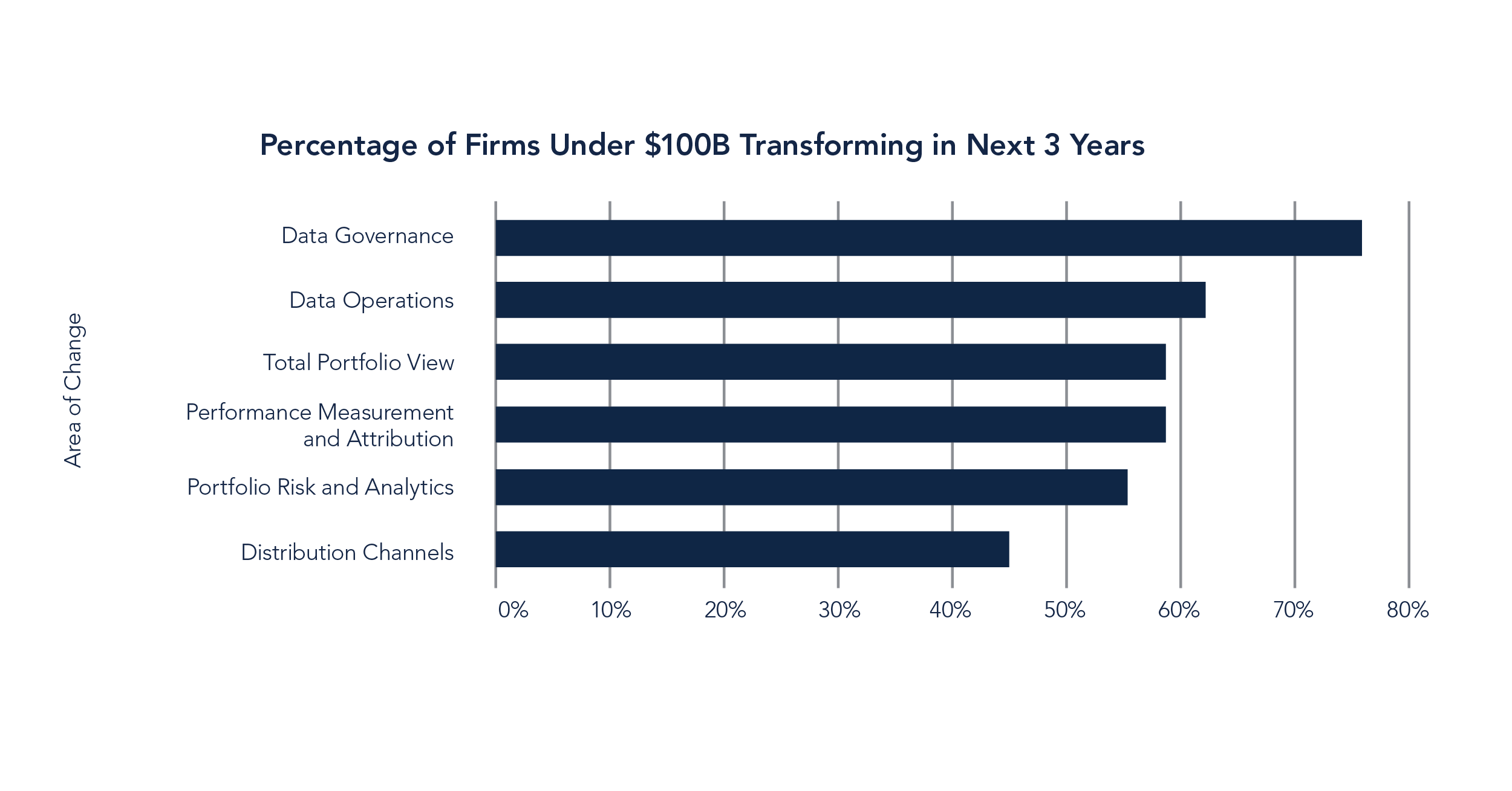
Among survey respondents, total portfolio view, performance measurement, and portfolio risk top the bill as areas of transformation—and for good reason. These are the foundational capabilities that smaller firms must transform to support their growth ambitions.
Data Architecture as a Priority
As firms diversify their holdings and products, they need clean, governed, and integrated data to support growth. That’s why 93% of firms with under $100B AUM have indicated that they are refining their data architecture across functions, and 76% have specifically said they intend to focus on data governance over the next three years.
Evolving Needs Make Demands on TPV and Performance
Total portfolio view is another critical priority. As firms expand across asset classes, they need a unified view of exposures, performance, and risk. Without it, they face fragmented oversight and limited decision-making power.
Performance measurement is also under pressure—not just to meet client expectations but to support operational resiliency and visibility. Interestingly, proprietary system and spreadsheet use for performance among firms under $100B is in line with larger firms. However, it’s worth keeping in mind that the homegrown solution for these firms likely differ from those at firms with over $1T AUM.
Types of Change
Across all functions, firms are pursuing two primary types of change:
- Replacing legacy systems
- Enhancing data integration
In 2025, over 65% of firms plan to enhance data integration across an average of three functions, 55% plan to replace legacy platforms, and most will deploy or upgrade systems across an average of four different functions. These efforts continue into 2026–27, with 65% of firms still focused on integration. The drivers are consistent: improved governance, operational resiliency, and AUM growth. But the execution is complex.
Complexity and Structural Blockers
Timelines Shaped by Internal Constraints
Firms under $100B AUM anticipate change programs to span an average of 17 months—an expectation shaped by industry norms rather than fixed realities. While projects at this scale often involve multiple systems and teams, duration is rarely dictated by scope alone. Internal resourcing, integration capabilities, project dependencies, and budget constraints all play a role.
In contrast to firms over $1T AUM, where scale naturally extends delivery, smaller firms are more acutely impacted by internal limitations. With the right support, however, timelines can often be compressed.
38% of Firms Report Roadblocks, Particularly in Performance Measurement and Attribution
But even with realistic timelines, many projects face significant hurdles. Not all initiatives move forward as planned, and the reasons are structural, not just circumstantial. Based on our experience with firms of this size, internal system dependencies—particularly involving OMS, accounting platforms, and data warehouses—are common culprits.
- 23% of all projects experiencing roadblocks cite critical internal system dependencies.
- 20% of projects struggle to size the problem or build a compelling business case.
- 19% of projects blocked or cut short because of lack of SME to define, execute, or realize project.
These are not minor delays; they are structural blockers that threaten transformation itself.
The Path Forward
Balancing Ambition with Capacity
Firms under $100B AUM are clear on their goals. Their transformation agendas reflect a clear desire to grow, innovate, and modernize. But ambition alone isn’t enough. Smaller asset managers face structural constraints that make transformation harder to execute. Legacy systems, lean internal teams, and operational complexity limit their capacity.
Technology is central to their evolution, but it’s not just about adopting new tools. Success depends on building the operational resilience to support change, integrating systems across functions, and prioritizing foundational improvements that unlock long-term scalability.
Why External Support Matters
For many of these firms, transformation pressures are more acute. Many operate lean teams without dedicated PMOs, making it difficult to scope, fund, and execute initiatives. Resourcing gaps, unclear business cases, and lack of subject matter expertise are common blockers.
Despite these challenges, foundational change remains a priority. Firms are actively working to refine data architecture, enhance integration, and replace legacy platforms. But without the internal capacity to size the project or sustain deliver, progress is often slow—or abandoned altogether.
This is where external support becomes essential. For firms operating with lean teams and limited transformation experience, the path forward depends on bringing in the right partners. Not just to advise, but to lead, deliver, and accelerate change.
Want to See Where You Stand?
Let’s dive deeper into the data and discuss what it means for your transformation roadmap.
Hit the Ground Running
Discover how we can help design and deliver solutions for any business challenge.
From design to delivery, we're your partner at every step
Citisoft provides senior executives and key stakeholders with actionable business solutions. We partner with our clients to solve today’s complex challenges and make informed decisions that enable tomorrow’s opportunities. Our services transform organizations, improves operational efficiency, and ensures that our clients are leveraging technology to support current and future business objectives.

We have the expertise and track record to design and deliver projects of any scope.
Discuss your needs with an expert and discover how we can help.
Survey Methodology
The 2025 Transformation Survey was designed to capture a point-in-time view of operational maturity, strategic priorities, and transformation roadmaps across the investment management industry. The survey focused on both current-state operations and forward-looking change agendas, with a particular emphasis on investment operations, data management, and technology enablement.
Survey Design
The question set was developed in collaboration with domain experts across Citisoft’s global practice areas. It includes a mix of multiple-choice, Likert-scale, and free-text questions, structured to allow both quantitative benchmarking and qualitative insight. The survey was refined from previous years to improve clarity and expand coverage of emerging topics (e.g., AI, digital assets).
Participants
Respondents included senior leaders and decision-makers from 68 asset managers, asset owners, insurers, sovereign wealth funds, and other institutional investment entities. Participation was by invitation, targeting firms across North America, EMEA, and APAC to build a representative industry sample.
Data Collection
The survey was conducted digitally between 3 July and 21 August 2025, with responses anonymized to encourage candor and protect firm-level confidentiality.
Limitations
While the survey captures a broad cross-section of the industry, findings should be interpreted as directional rather than exhaustive. Some questions allowed for multiple selections or free-text input, which may introduce variability in interpretation.