





Private Credit: Is Your Operating Model Ready?

Jointly authored with BlackRock's Matthew Burger
Don’t have time to read now? Take it with you!
Download PDF
Private credit has emerged as one of the fastest-growing segments in alternative investments thanks to an impressive decade of growth following the Global Financial Crisis. As investors increase allocations and new market entrants reshape the landscape, firms must rethink their operating models to stay competitive. Positioning for scalable growth demands more than incremental change—it calls for a strategic transformation across technology, data, and partnerships. From acquisitions and B2B alliances to the latest advances with comprehensive investment platforms, the ability to integrate public and private market operations is increasingly vital.
This whitepaper explores the critical challenges and considerations for firms navigating the evolving private credit space. Whether you're scaling existing private credit operations looking to enter the asset class. Discover how leading firms are building resilient, scalable models to unlock value in today’s dynamic private credit space.

The Oldest Form of Investment Finally Arrives
Despite being a form of investment that dates to antiquity, the supply of private credit and investor allocation to the asset class has taken off the past two decades. General partners, large asset owners, and asset managers are happily filling the credit supply gap left by larger banks. With companies staying private longer and more innovative sales and distribution, the opportunity set for both managers and investors is growing. At the same time, sponsors and investment managers are creating sticky, higher-margin products.
The asset class is proving to be a valuable tool for those looking to earn an additional illiquidity spread premia over a public credit investment with a similar credit risk profile. Increased participation and allocation show that alternatives are no longer an alternative, with institutional investors’ alts allocations averaging 29% in 2024 and private credit’s portion totaling $1.7 trillion in AUM (Preqin; Figure 1). Further, estimates of 2x growth by year-end 2028 are bolstered by anticipated new allocations from retirement accounts and retail channels.
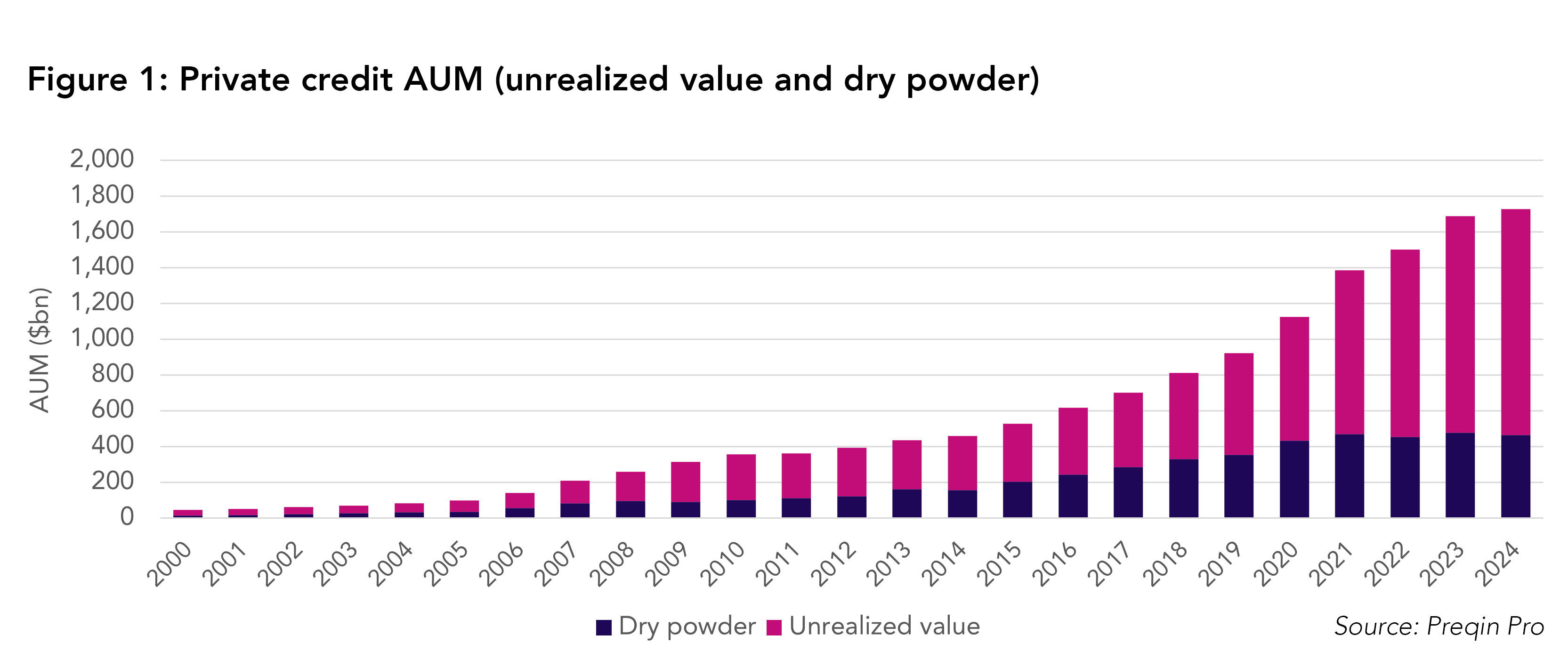
Figure 1: Private credit AUM (unrealized value and dry powder)
With a new set of participants in the market and product innovation altering the landscape, the challenge for COOs and CTOs is finding an operating model solution that fits each firm’s unique aims. Private credit has clearly risen beyond niche status and “fast follower” operating model questions are top of mind:
- How do we leverage technology to capture market opportunity and drive profitable growth?
- How do we create an advantage with partnerships or technology?
- Are front-to-back systems capable of handling consolidated public and private data and accounting books?
For those making operating model decisions, there are, in our view, three primary influences driving change: acquisitions, business-to-business partnerships, and the capabilities of comprehensive investment platforms.
Acquisitions
Many firms have made the decision to bring private credit investing in-house or supplement their current capabilities via acquisition. While not relevant for all market participants, general partners, insurance companies, and larger asset managers are acquiring private credit managers (e.g., infrastructure, real assets) and making initial decisions on operating model integration. Acquisitions have been elevated in recent years as firms seek breadth across the private credit spectrum and pursue more unique credit origination channels.
Operating Challenges |
Key Considerations |
|
Industry goal: Integration of investing and operational workflows |
Business-To-Business (B2B) Partnerships
There is significant momentum in creating joint partnerships and co-investment vehicles, many of which seek to provide investors with a one-stop shop for private credit and public markets exposure. Partnership announcements, such as Vanguard-Wellington-Blackstone and Invesco-Barings, are regular occurrences today.
B2B partnerships are also pushing the boundaries of how private credit investments can be deployed and encouraging new sub-advisory relationships—those unique relationships that will directly impact results and profitability. Partnerships are also helping drive the evolution of balanced funds, interval funds, and CITs as firms ramp up for retail and retirement capital accumulation.
Operating Challenges |
Key Considerations |
|
Investors revisiting appetite for direct investment Servicing partners remain a key relationship for fund managers |
Comprehensive Investment Platforms, Inclusive of Private & Public Markets
Typically, private credit success has been tied to a firm’s flexibility and creativity in origination. As the wave of private credit transactions grows, scalability has established itself as another key driver. After firms make intentional business and B2B partner decisions, they can begin to effectively plan their private credit technology and operations journey. For general partners and large alts shops, the increasing complexity, volume, and number of partners are driving the need for a sound data backbone that is both compliant and scalable. For asset managers and complex asset owners, taking on direct private credit opportunities could mean expanding the use of current investment platforms or buying specialized technology. Complexity and integration challenges are unavoidable to some extent.
Private credit requires the same rigorous investment, operations, and administration support as public markets, but scaled technology that handles both investor and administration needs effectively has been elusive. Recent investments by vendors in private markets capabilities have brought welcome change, notably in the ability to deliver comprehensive analytics and risk management across public and private markets. In a world constantly searching for the big picture, holistic investment platforms are delivering whole portfolio insights.
Operating Challenges |
Key Considerations |
|
Acquisition and partnership backbone A whole portfolio view across public and private assets is the ultimate goal |
Readying Your Operating Model for Private Credit
Approached prudently, private credit can diversify fixed income portfolios, commanding higher yields and providing a complement to traditional public markets. Yet the potential benefits, including alpha, can be quickly undone if the bespoke nature of deals and irregular data lead to reliance on highly manual processes.
Taking a broad view, acquisitions, business-to-business partnerships, and comprehensive investment platforms are exerting outsized influence on operating model decisions for private credit. For firms interested in tech solutions that facilitate private credit investing—especially those that have also been seeking a holistic view across both public and private assets—comprehensive investment platforms deliver an increasingly compelling offering.
In the end, as with all operating model change, the path to private credit investing should be carefully plotted based on each firm’s unique goals and organizational traits. The available solutions for supporting that change are finally catching up with the investment opportunity, and though private credit has grown dramatically in the past decade, there are signs that it’s early days yet.