





Outlook 2026: Navigating Scale and Specialization

Fee compression, data modernization, and digital acceleration have been topics of discussion for well over a decade. Yet firms are today confronting a more fundamental question: how to grow in a market that is now, more than ever, demanding greater scale and deeper specialization.
Ready to transform your business in 2026?
Download PDF
Across the globe, client expectations are reaching new heights, product innovation is being fast-tracked, and the operating model is now being scaled to anticipate opportunities only just emerging on the horizon. This year the most successful firms will be those whose operating models are designed to anticipate tomorrow’s demands, not just address today’s challenges.
Influences for 2026
- System Interoperability upends the best-of-breed or single-platform dichotomy
- Automation and AI shift from tactical to strategic
- People strategy becomes even more important thanks to AI

Shifts Affecting the Industry’s Psyche
If the influences outlined above represent the forces reshaping operating models, these broader shifts capture the mindset behind them. They reflect how firms are recalibrating priorities in response to structural pressures and emerging opportunities. Each shift marks a transition from reactive adaptation to proactive anticipation, prompting a deeper rethinking of growth strategies and competitive positioning.
Private Assets as a Growth Lever
While public markets remain foundational for institutional investors, private assets are increasingly seen as a source of alpha, diversification, and differentiation – especially in a low-yield environment.
Fee Pressure
Clients continue to demand lower-cost options, forcing firms to balance cost efficiency with innovation and service quality. The industry is rethinking value delivery, exploring new pricing models, and leveraging scale to remain competitive in an environment where transparency and performance are under constant scrutiny.
Product Innovation
Managers are under pressure to differentiate, and that means rethinking the product mix. Beyond traditional vehicles, firms are exploring structures that offer liquidity, transparency, and operational efficiency. Tokenization is emerging as a focal point, driven by demand for fractional ownership and faster settlement. This shift is already playing out, with leading players embedding tokenization capabilities into their platforms, while others are publicly predicting a token-first future.
Client-Centric Digital Transformation
Wealth and high-net-worth clients increasingly expect hyper-personalized experiences, including tailored reporting and near-real time insights. While these demands are not universal – since institutional clients prioritize robustness and scalability over immediacy – they expose the limitations of legacy architecture. Traditional systems struggle to reconcile these divergent needs, and bespoke solutions combined with the lack of standardization often extend implementation timelines.
To address this, firms are aiming to deliver frictionless, customized experiences without compromising security, scalability, or operational efficiency. This is accelerating investment in modular platforms, cloud-native solutions, and advanced data integration.
Technology-Driven Efficiency
Advances in automation, AI, and data integration are enabling firms to streamline operations and deliver more value to clients. The leading multi-asset, enterprise-wide platforms are working hard to optimize workflows across front, middle, and back-office functions, driving significant gains in efficiency and productivity.
Buy-side firms are already benefiting from innovations in APIs, natural language processing, and data connectivity. However, while these technologies are reshaping operational processes in pockets of the industry, most AI-first applications remain in the early stages and deliver tactical improvements rather than fully transformative change.
Asset Manager Consolidation
Competitive pressure and the need for scale are driving M&A and strategic partnerships, with consolidation efforts coalescing assets to achieve economies of scale, enhancing the breadth and diversification of product offerings and ultimately delivering operational efficiency. These moves are not just about growth. They’re about accessing new asset classes, new geographies, and building capabilities that position firms for long-term sustainability.
Internal Consolidation for Efficiency
Firms are rationalizing legacy structures from decades-old acquisitions, identifying opportunities to pool assets under management and streamline operations. In some cases, asset managers acquired decades ago are only now being integrated, unlocking scale by combining complementary investment capabilities. Elsewhere, firms are consolidating investment teams with portable assets under unified leadership to drive cohesion, efficiency, and competitiveness.
The Outsourcing Pendulum Swings Back
The world’s largest asset owners are bringing front office functions back in-house, citing high costs and limited value from outsourcing portfolio management. This trend is particularly visible among insurers and pensions who are reclaiming control to reduce fees and improve alignment. These moves tend to start with insourcing and then layering selective partnerships for trading or operations.
Our Outlook explores the new and continued forces shaping our world as well as the shifts that define the path forward.
Outlook 2026 – What It Means for Your Firm
Operations to Enable Strategic Growth and Scalability
Last year, we spoke about the need to move beyond incremental efficiency gains toward value-driven operating models. That imperative has only compounded. In 2025, firms continued to focus on rationalizing legacy systems and embedding agility into their operating structures. In 2026, those same imperatives will intensify as private markets growth accelerates and tokenization begins to feature more prominently in strategic conversations. While adoption remains uneven, regulatory developments and distribution-focused pressures are ensuring the topic stays on the radar.
The complexity introduced by these trends means that operating models must now anticipate—not just react to—market evolution. Failure to do so risks creating structural bottlenecks that undermine growth ambitions.
Findings from Citisoft’s 2025 Transformation Survey reinforce this urgency. Growth emerged as the most cited driver for change, with firms prioritizing transformation efforts that future-proof their organizations.

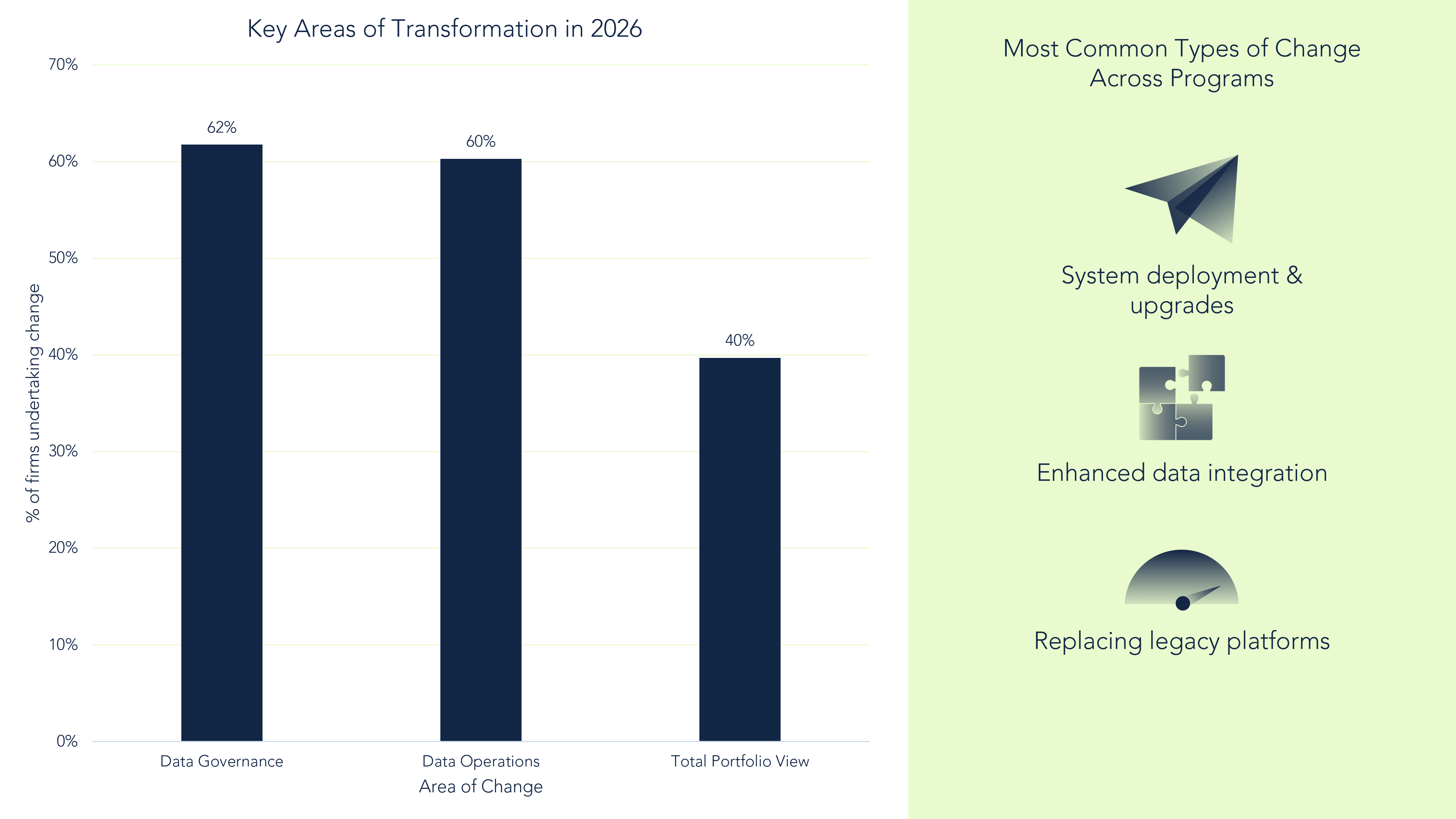
Transformation initiatives for 2026 are concentrated in three areas:
- Data operations and governance, ensuring consistency and quality across increasingly complex asset mixes.
- Total Portfolio View (TPV), reflecting the industry’s push to break down silos and deliver consolidated risk and performance insights across public and private markets.
- Integration and modernization, with firms prioritizing enhanced data connectivity and the replacement of legacy systems as the most common levers for change.
The implications extend beyond technology. Firms must embed scalable processes that anticipate future complexity, not just current demand. Automation and AI will play a critical role in reducing manual intervention and accelerating access to business and investment insights, but technology alone is insufficient. Talent strategies must evolve to build blended expertise, with teams that combine deep operational understanding with strategic insight and the technical fluency needed to deploy innovative technologies effectively across the enterprise. Vendor relationships and outsourcing models also need recalibration to ensure agility and resilience in a market where speed, accuracy, and interoperability are competitive differentiators.
Ultimately, operations is the foundation that enables the growth engine to perform. Firms that succeed will be those that treat operations as a source of strategic value; capable of driving differentiation, supporting innovation, and enabling the scale required to compete in a market defined by complexity and rapid change.
Influences on Op Model Conversations in 2026
Though the mindset is shifting within the investment management industry to regard operations as an enabler of strategic growth, conversation about those operating models continues to orbit familiar centers.
Firms see opportunities (or challenges) in four areas:
- Capability opportunities focus on growing the firm’s abilities to do something they don’t at present.
- Efficiency opportunities seek to do more with the resources they currently have.
- At the intersection of capability growth and efficiency lie scalability opportunities, which consider how to deliver more without a proportional increase in resources or expenses.
- Control opportunities span the prior three to mitigate the potential for existing or aspirational activities to fall outside of internal or external governance requirements
Over the next 12 months, amid the considerable change and uncertainty affecting the industry, we see three themes exerting the greatest influence on conversations regarding operating models and their potential to drive growth and scalability:
- Automation and AI
- Solution optionality
- People strategy
The reason for these three as opposed to the countless other trends? All three hold the potential to deliver value across all four opportunity areas. In other words, for managers small and large alike, these themes are influencing operating models in myriad ways according to the unique needs and opportunistic targets of each firm.
The flip side of that flexibility and potential is complexity. The combination of AI and interoperable vendor and platform solutions are introducing increased optionality for your operating model. While this offers many opportunities for success and differentiation, it also means that there is a potential to take the wrong path. Though even the most rigorously devised strategy can fail, thoughtful consideration of where your business stands today and where you want to be tomorrow—plus a dose of experience-honed expertise—betters the odds.
Finally, overarching every transformation initiative as its keystone is the people that make every operating model tick. While AI may be reshaping operating models, the prevailing narrative is about empowerment, not replacement. Forward-thinking firms are focusing on upskilling and enabling teams to shift from repetitive, manual tasks to higher value activities that drive innovation and client outcomes. It is more important than ever to carefully execute a people strategy that positions your firm for success today as well as to ensure resilience and competitiveness in the years ahead.
Automation and AI Shift from Tactical to Strategic
Across the industry, there is a shift in attitudes toward AI. Initial excitement that drove a spaghetti-meet-wall approach, is giving way to the realization that even the vanguard of agentic AI has a way to go before it is ready to deliver specialized value to a business without considerable investment.
As enticing as AI’s potential is—with McKinsey sizing it as 25–40% reduction in the average asset manager’s cost base—pursuing a laundry list of bottom-up use cases will not deliver meaningful ROI. The bigger issue: even successful tactical deployments yield muted benefits if layered onto an operating model laden with legacy technology and inefficient processes. Putting Pirellis tires on your 2008 Civic won’t get you to work faster.
The result is a move to exploring strategic applications, built on a holistic understanding of operations and its people, processes, and technology. The essential ingredient in this foundation is, of course, data. Educated by lackluster and even at times inaccurate outputs, leaders understand that well-governed, high-quality data is the prerequisite for value at scale. We already see this orientation leading to action—in our 2025 Transformation Survey, 88% of firms are implementing or exploring AI capabilities and a likewise nearly 90% plan to transform their data operations and governance in the coming years.
With data management poised to support AI, we see three practical paths to implementation in 2026:
- Proprietary AI Builds
- AI Features Embedded in Existing Platforms
- Novel AI Point Solutions
1. Proprietary AI Builds
Costly in the requisite skill-development, time, and monetary investment, in-house development of AI capabilities gives firms the greatest control over risk management and offers dramatic potential for differentiated, long-term value. Morgan Stanley’s DevGen.AI is a prime example. Developed in house and launched a year ago, by mid-year 2025 Morgan Stanley’s Mike Pizzi, global head of technology and operations, said it had reviewed nine million lines of code and saved their developers 280,000 hours by helping translate legacy code, such as Cobol, into plain English and, at times, modern code.
2. AI Features Embedded in Existing Platforms
Readily accessible with little or no incremental expense but with varying levels of impact and significant question marks around security and governance, AI features in existing tech are everywhere. Throughout 2025, AI was a major talking point for vendors, both in terms of functionality launches and product roadmaps.
With almost every vendor touting AI capabilities, investment ops teams are getting exposure to AI beyond the now omnipresent generative AI platforms including ChatGPT (often via Copilot), Claude, and Gemini. In fact, the starting point for many vendors has been to integrate one of the leading LLMs as an on-platform assistant, able to quickly locate information or draft a SQL query.
Though the accessibility of these features is appealing, if the model touches personally identifiable or material non-public information, it’s essential to ensure that strong isolation, encryption, and geographic controls are in place. Further, applications will unavoidably be limited to the software than the enterprise value chain.
3. Novel AI Point Solutions
Offering AI-native capabilities that go beyond what’s possible when piggybacking on public, generalist models, new AI point solutions sit between proprietary builds in terms of their required investment and value. In this nascent space, vendors solving for specific micro processes, such as trend analysis or portfolio rebalancing, are showing what specialized AI applications can deliver by targeting clusters of use cases. Vendors such as MDOTM and Boosted.ai are adding impressive names to their client rosters but as with any vendor search, due diligence for AI point solutions is vital to ensure that managers are not introducing undue risk to their op model.
Finding the Right Path to AI Value in 2026
With many firms appropriately focused on upgrading their data architecture and governance as the necessary foundation for AI and the breakneck speed at which AI capabilities evolve, it’s difficult to predict what 2026 holds for AI in the asset management industry. We are certain, however, that it will continue to be a frequent topic of conversation and likely a significant consideration influencing op model conversations.
The bottom line: regardless of the path they take or the tools they use, the firms that make the shift to strategic applications of AI and do so with the aid of a modern and well-governed data architecture will be those that lead in the race to deliver on the hype.
Solution Optionality Upends the Best-of-Breed or Single-Platform Dichotomy
While AI continues to get the lion’s share of headlines, interoperability has become the defining feature of modern operating models. Far from a passing buzzword, interoperability signals a decisive industry shift towards open architecture and API-first strategies that enable flexibility, connectivity, and simplicity across investment operations. Firms are prioritizing solutions that integrate within an ecosystem, allowing them to choose, combine, and evolve technologies without being locked into a single platform—a principle we call solution optionality.
Solution optionality is about maximizing choice and adaptability, enabling firms to respond quickly to changing market and technology demands. This desire for optionality is nothing new, but demands on operating models have intensified in recent years. Today’s operating models must support an expanding mix of public and private assets (not to mention digital assets), realize the potential of M&A, and serve a more diverse set of internal data consumers. All this is happening against a backdrop of pressure to simplify front-to-back architecture, and thoughtfully rationalize systems by identifying where specialization and differentiation are necessary and where they are not.
The old best-of-breed versus all-in-one debate is effectively over. In practice, very few firms operate on a true single stack; most “front-to-back” solutions are collections of interoperable components. Modern app architecture and data consumption simply don’t support a monolithic approach, especially in a world of SaaS and specialist data providers. What firms need is an interoperable backbone: a flexible, connected foundation that allows them to assemble, adapt, and scale their operating model as needs evolve.
It’s hardly breaking news that ops teams are being asked to do more with less, but the game has changed. Today’s vendors are delivering genuine flexibility and connectivity, moving beyond the old best-of-breed versus front-to-back debate thanks to their commitment to optionality. This shift is largely driven by front-office demands to retain their preferred platforms, forcing service providers to collaborating within the same operating model. Open architecture and a robust, integrated ecosystem have become core messages when showcasing the advantages of their platforms.
At the same time, vendor M&A routinely revises the menu of available options, bringing complementary functionality and bolt on specialisms to platforms and taking advantage of unified data architecture and its capabilities.
Solution optionality empowers managers. The choice is no longer between best of breed and a single platform. Instead, firms can reap the benefits of unified data capabilities and accommodate their unique needs without taking on risky customization.
People Strategy Becomes Even More Important Thanks to AI
Technology strategy only works if people strategy keeps pace. For all the potential that AI and today’s flexible, interconnected solutions hold, operating models don’t stand a chance if the people part of the operational equation is neglected. In 2026, as firms accelerate efforts to harness AI, the conversation is less about replacing people and more about enabling teams to focus on higher-value work. While AI can automate repetitive tasks, success depends on thoughtful workforce planning. Upskilling, redeploying talent, and ensuring tech fluency remains central to transformation.
This year, there are three themes shaping conversations around people and talent in our industry:
- The continued squeeze on legacy expertise;
- The rise of ‘expert-plus’ talent;
- and questions around collaboration.
Despite AI Support, Waning Legacy Expertise is Still a Risk
Amid the impressive acceleration of tech modernization, there is still a reliance on knowledge of mainframe knowledge and legacy-languages that is too large to ignore. Baby Boomers are retiring later than previous generations but retirements are still a factor when considering the already thin pool of experts in a programming language developed 50 or more years ago.
This shrinking supply of knowledge is also an issue when it comes to training others—as well as AI models—on these languages. Though the potential for AI to support the transition from legacy code is already bearing fruit with Morgan Stanley’s DevGen.AI as a prime example, firms still need experts that can validate the outputs of large language models as they learn how to translate from old to new.
It's No Longer Enough to Be an Expert
Driven by the rapid expansion of data over the past decade and now meteoric rise of AI, firms are increasingly demanding that roles are filled by people who pair business acumen with data, tech, and AI skills. For new hires, data and AI fluency are increasingly core skills developed during their education. For hires with industry experience, the ability to seamlessly integrate data and AI abilities is more common an area for development. Though ‘expert-plus’ employees are becoming more common thanks to significant upskilling efforts, the need for training and development is still essential to building a workforce with the necessary balance of skills—as well as one that will continue to reflect that balance in 10 years.
Is Collaboration Still Clicking?
Since 2020, most firms have re-oriented around hybrid collaboration. Even as return-to-office mandates have grown more popular, data and anecdotal evidence alike indicate that the hybrid work model is here to stay. Yet the persistence of remote work is accompanied by ongoing operational risks due to changes in communication, compliance, and onboarding practices that have improved but still lag the state that took decades to build and refine.
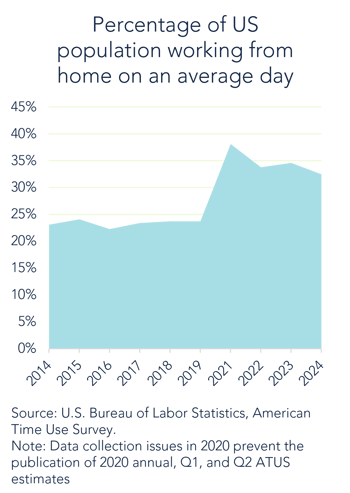
And of course, we’re dancing around the elephant in the room: company cultures have been dramatically affected. New technology facilitates remote work in remarkable ways but collaboration is diminished. Especially when it comes to the complex change initiatives that firms are undertaking, the correlation between increasingly remote connections and the number of transformations that are delayed or over budget is too significant to ignore.
This is not to suggest that remote work is always to blame, but it’s our perspective that there are occasions where it’s necessary to sit down in the same room and leave only when decisions are made. There are ample roles and tasks where remote work is effective, at times even more so than office work. In our experience, the dynamic, uncertainty-laden, cross-firm and cross-departmental work of change management is less likely to benefit from remote-only distance.
Take Action for Strategic Growth
The pace and complexity of change show no signs of slowing. Firms are navigating fee pressure, product innovation, technology-driven efficiency, and the imperative to scale through consolidation and strategic partnerships. The operating model must stand to be an engine of growth, differentiation, and resilience.
Three themes stand out as critical for success: the strategic adoption of automation and AI, the embrace of solution optionality and interoperability, and the evolution of people strategy to meet the demands of a hybrid, tech-enabled future. These are not isolated trends; they are interconnected forces that will define the winners in a market where agility, data quality, and talent are the true sources of competitive advantage.
Citisoft is uniquely positioned to enable firms to turn these challenges into opportunities. With deep expertise across operations, technology, and change management, Citisoft partners with clients to design and implement operating models that anticipate future complexity, unlock strategic value, and enable sustainable growth. Whether you are reimagining your data architecture or optimizing operations against new product demands, Citisoft brings the insight, experience, and collaborative approach needed to deliver lasting impact.

Let’s shape the future of your firm together.
If you are ready to accelerate your transformation journey, or
simply want to discuss how these trends might affect your firm,
we invite you to get in touch.