






.png?width=760&height=550&name=Blog%20-%20Featured%20Images%20-%20500%20x%20500%20(15).png)
The term “investment book of record" or ‘IBOR’ has been kicking around the investment management industry for quite some time. For many firms, IBOR plays a key role in providing a timely, trusted, and consolidated source of positions and cash across the business. When that view is delayed, inconsistent, or not trusted—front office decision-making slows or degrades, operational risk increases, and reconciliation efforts grow.
Why IBOR means different things to different firms
I recently polled several industry veterans in my network, with the purpose of asking some of the best practitioner minds to opine on their view and definition of IBOR. While most would agree that IBOR outcomes center on timely, accurate, and complete investment position data, the way that capability is defined and delivered in practice varies considerably from firm to firm.
Differing views are situational with each practitioner creating their own interpretation based on requirements, use-cases, and system architecture. For example, one practitioner’s firm was solving a data consolidation challenge (e.g., public and private assets), whereby another practitioner’s firm was challenged by producing more timely positions and cash due to inefficient and siloed operational processes.
Across these perspectives, there are clear shades of gray in how IBOR is defined, with interpretations shaped by what firms are trying to achieve, how they deliver it, and where it breaks down.
why ibor is not a singularly defined capability
I believe nuances around IBOR capabilities emanate due to three factors:
- Lack of an industry adopted standard definition.
- Differences in investment manager and asset owner interpretations.
- Inconsistent use of definitions with vendors and service providers.
A practical way to think about IBOR
Rather than expecting everyone to align to a single definition of IBOR, it is more useful to frame what I’ve seen as the components of an IBOR. Not just the Investment ‘Book of Record’ itself (e.g., the data outcome), but the means to produce and consume the IBOR data.
When I’ve worked with clients on IBOR engagements, it's typically because they are struggling to efficiently produce a reliable ‘book of record’ and then make that data accessible and timely to end consumers. On some engagements, IBOR becomes the backbone of a broader transformation—shaping platform selection, operating model design, and how investment data flows across the organization. In other engagements, firms are focused on consolidating bespoke IBOR platforms and processes into a centralized platform to deliver timelier and more accurate positions and cash.
The four components of IBOR
In my view—the four components of an IBOR solution are:
- Data
- Platform
- Operational Processes
- Consumers
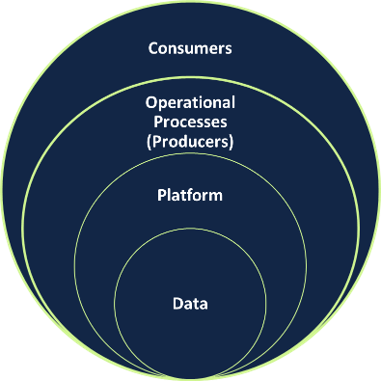
1. DATA: THE FOUNDATION
At its core, the IBOR is built on data, capturing all investment activities and other essential information. Mike Maltby discusses this in "IBOR Ownership, Outsourcing, and Data Quality: Keys to Delivering on the Hype”, where IBOR captures the “timely, accurate, and complete investment position data. In addition to start- and end-of-day snapshots, an IBOR offers intra-day views to support the full investment lifecycle.”
Firms often struggle with fragmented data architectures, batch processes, and data quality and normalization challenges.
2. PLATFORM: BRINGING THAT DATA TOGETHER
The supporting platform (system) aggregates, normalizes, validates, and stores the transactional and resulting data to produce SOD, EOD and intra-day accurate ‘trade date’ views of a firm's investments and cash.
| Author's note: the term platform here is a logical view and while a key objective is to have one set of all assets, investment managers could have multiple IBOR platforms supporting, for example, different asset classes or regions. |
For example, a large global firm may have different outsourced IBOR service providers in North America and Asia. Or a multi-asset shop may have different systems supporting public and private assets.
3. operational processes: producing the ibor
Next, the operational processes leverage the platform to ‘produce’ the IBOR data. These are key activities such as trade and cash processing, corporate actions, pricing, reconciliation, and reference data management to name a few. The complete set of operational processes is what enables a daily (or intra-day) portfolio recordkeeping function, which then keeps the trade date positions and cash up to date.
While an ideal goal is to have capability to support all IBOR-related processes on a single platform, this may not always be the case and other applications or sub-systems may be needed to undertake these bespoke processes. In which case, resulting outcomes (e.g., data) would be fed back to the consolidated IBOR platform.
4. consumers: where ibor delivers value
Lasty, there are consumers of the IBOR data – which include front office teams, as well as middle office operations, performance, client service, and other back-office teams. Data consumption can be in the form of interfaces/APIs, downloads, views, or reports. The IBOR data can be extracted from front office or operational systems, or from an IBOR Data Warehouse. In either case, mechanisms to ensure the data is ‘validated and ready for consumption’ is extremely important.
What a well-functioning IBOR enables
When these components work effectively together, IBOR enables:
- More timely and informed investment decision-making
- Consistent views of positions and cash across the organisation
- Streamlined and more efficient operational processes
- Reduced operational risk
- Scalable support for new products, asset classes, and client reporting requirements
With the IBOR components defined, it’s worth acknowledging there are many ways to solve your IBOR needs. Firms can construct their IBOR by leveraging software platforms, outsourced managed services, integrations, and data warehousing solutions. This can include a single platform or multiple sub-systems and services brought together. All of this contributes to the different flavors and views of defining an IBOR.
As far as having a true ‘real-time’ IBOR, firms are making progress in eliminating batch processes surrounding key activities. However, we are not quite there in totality. While the intra-day IBOR is certainly a reality, the industry participants and vendors continue to chip away at IBOR-related transaction lag times.
So, what's needed to bring greater clarity to IBOR?
Rather than focusing on a single, standardized definition, firms benefit most from understanding how these components come together within their own operating model—and where gaps exist across data, platform, processes, and consumption. If an IBOR is not timely, trusted, and consistently used across the front, middle, and back office, it is unlikely to deliver on its intended value.
However, as industry consultants leading IBOR conversations and designing and implementing solutions with clients and the vendor / service provider community, we must continue to surface these gray areas and help bridge gaps and bring clarity to this topic. This is certainly an achievable goal. After all, I circled back with the same group of industry veterans mentioned at the start of this blog, and I’m happy to report we’re now aligned on IBOR definition. Progress made!
Tags:


Ken Barnet
Ken provides strategic direction and leadership on Citisoft programs in North America and globally. He has over 30 years of experience providing both advisory and delivery services to asset managers and service providers of all sizes. Ken is a leader of complex, enterprise-wide programs, with specialties including strategic IT and operational assessments, operating model transformations, operations outsourcing transitions, and vendor software selections and implementations. His expertise spans asset classes ranging from equities and fixed income to derivatives and alternatives, and functional areas covering front, middle, and back office.
.png?width=200&height=200&name=Blog%20-%20Featured%20Images%20-%20500%20x%20500%20(1).png)

Comments