







Co-authored by Ken Barnet, and Chris Guild.
Citisoft recently surveyed global asset managers on their transformation agendas over a three-year time horizon. It revealed a clear signal from the industry’s largest players. Firms managing over $1 trillion in AUM are prioritizing growth and actively rethinking the technology foundations that support it.
Defining Legacy and Proprietary SystemsIn line with use of ‘legacy’ and ‘proprietary’ in Citisoft’s 2025 Transformation Survey, we use the two as distinct terms. Legacy is a broad term describing outdated technology. On the other hand, proprietary refers to technology that has been developed in-house rather than by external vendors. Proprietary systems are often but not always legacy. Legacy systems can include vendor-built as well as proprietary technology. |
The use of proprietary systems is still prevalent among this group, especially in data operations, performance and attribution, and regulatory reporting. Yet our survey’s findings point to a strategic shift already underway. In 2025, replacing legacy systems has been at the forefront—with an emphasis on data platforms—along with enhancing data integration. In 2026, the plan is to build on the move from legacy and invest further in data integration.
Before we dive further into the findings, let’s acknowledge the elephant in the room: we’ve been having this conversation for well over a decade. The industry has been promising transformation, plotting the end of proprietary platforms, and forecasting a future built on scalable, integrated tech for fifteen years—and yet, here we are about to enter 2026, still wrestling with the same legacy obstacles. It’s almost surreal that trillion-dollar firms are still tangled up in systems that should have been retired years ago.
The stakes are high over the next year. Among the largest firms in the industry, more than one-in-three are relying on homegrown systems for foundational data functions. With growth goals hinging on initiatives that seek to replace deeply rooted legacy data technology, it seems likely that the first firms that effectively navigate this transition will be poised to lead their cohort in maximizing the value from investments in AI and new asset class capabilities, including alternatives. On the other hand, the sizable group relying on proprietary data management solutions today should consider whether their technology architecture foundation is ready to scale, if they’re not in camp already working to modernize.
Growth-Driven Transformation for a Diverse Asset Class Future
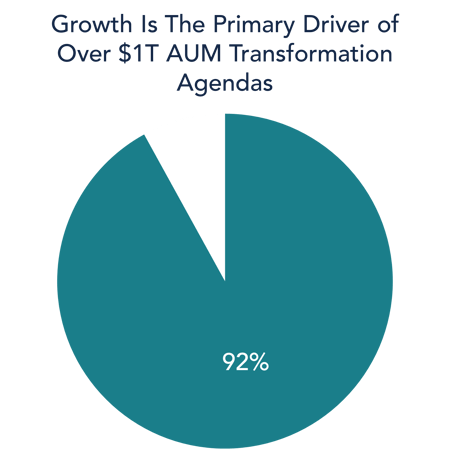 The majority of trillion-dollar firms surveyed cited growth as the primary driver of their transformation agenda. While growth has always been a strategic goal, the urgency has intensified this year. Firms are no longer just aiming to increase AUM, they’re actively reconfiguring their operating models to compete in a more competitive and fast-moving environment.
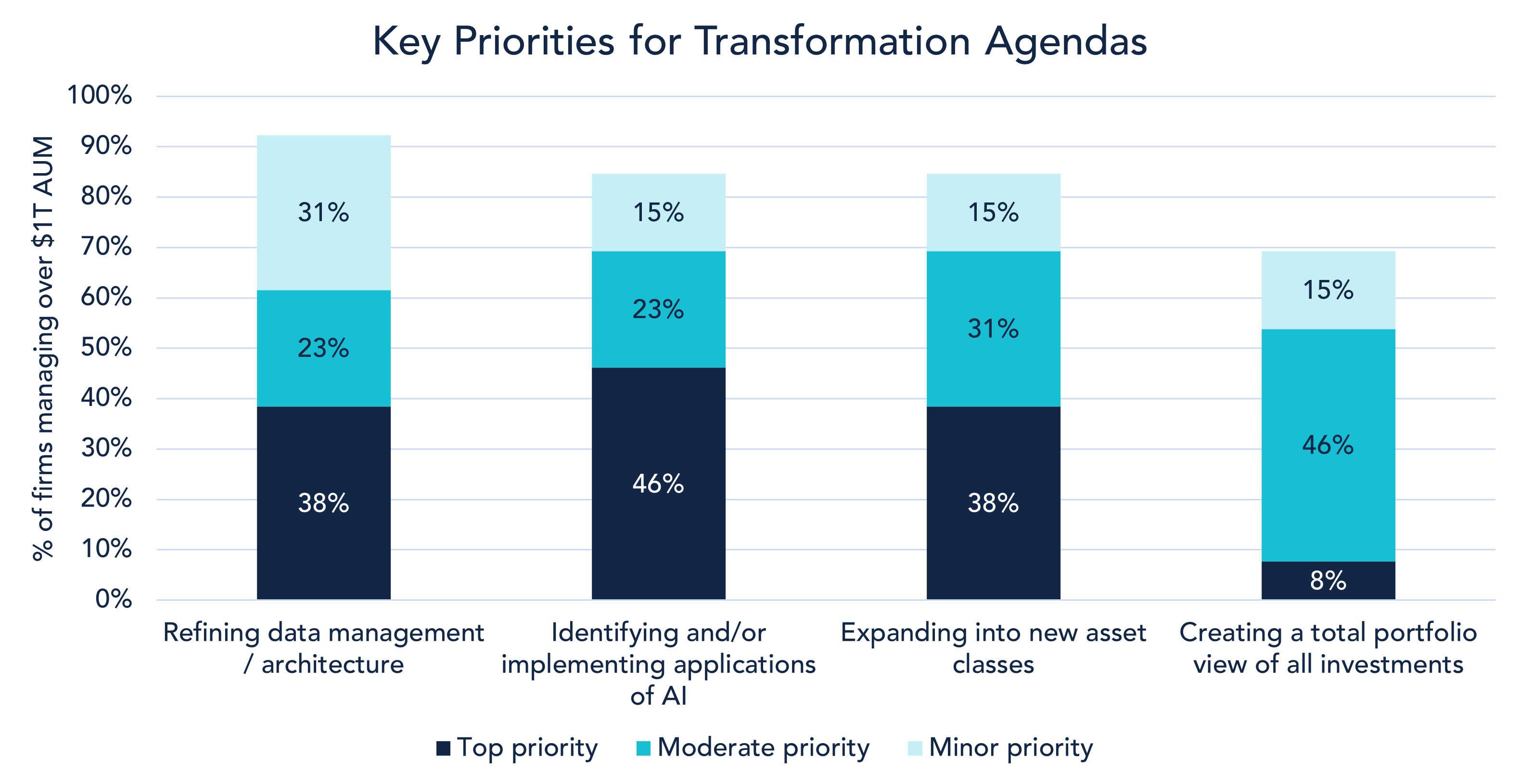
A key factor behind this urgency is asset class and investment vehicle expansion. Nearly 70% of firms with over $1T in AUM placed the ability to support new asset types, such as private markets and digital assets, among their top to moderate transformation priorities. The diversification is not only about tapping new revenue streams, but also about staying competitive in traditional asset classes (e.g. equities and fixed income), where margins are tightening and differentiation is harder to achieve.
At the same time, M&A activity is reshaping the competitive landscape. Larger entities are emerging, intensifying competition and forcing incumbents to modernize. Meanwhile, small and mid-sized firms are upgrading their operating models to offer more attentive service and targeted capabilities, drawing attention away from the biggest players and forcing larger firms to rethink how they scale without sacrificing agility.
Growth is increasingly tied to the ability to support new asset types, manage complexity, and deliver operational efficiency. To support their ambitions, firms are confronting the limitations of their legacy technology stacks, particularly proprietary ones that struggle to meet the scale, complexity, and integration demands of a diverse asset class business strategy.
Why Proprietary Systems Are Falling Short in Asset Management
Among trillion-dollar firms, proprietary builds still dominate—for instance, 62% of firms use proprietary data platforms for data functions versus 36% across the industry—but they’re increasingly misaligned with strategic needs.
Historically, these systems were developed to meet complex requirements that vendor solutions couldn’t yet support. In many cases, firms needed specific architecture to handle scale, customization, or asset class-specific capabilities that simply weren’t viable through third-party platforms at the time. Proprietary tools filled critical gaps in functionality and workflow, especially in areas where vendor ecosystems were immature or fragmented.
Today, however, those same systems are often barriers to progress. Integration challenges were identified as a major concern for respondents.
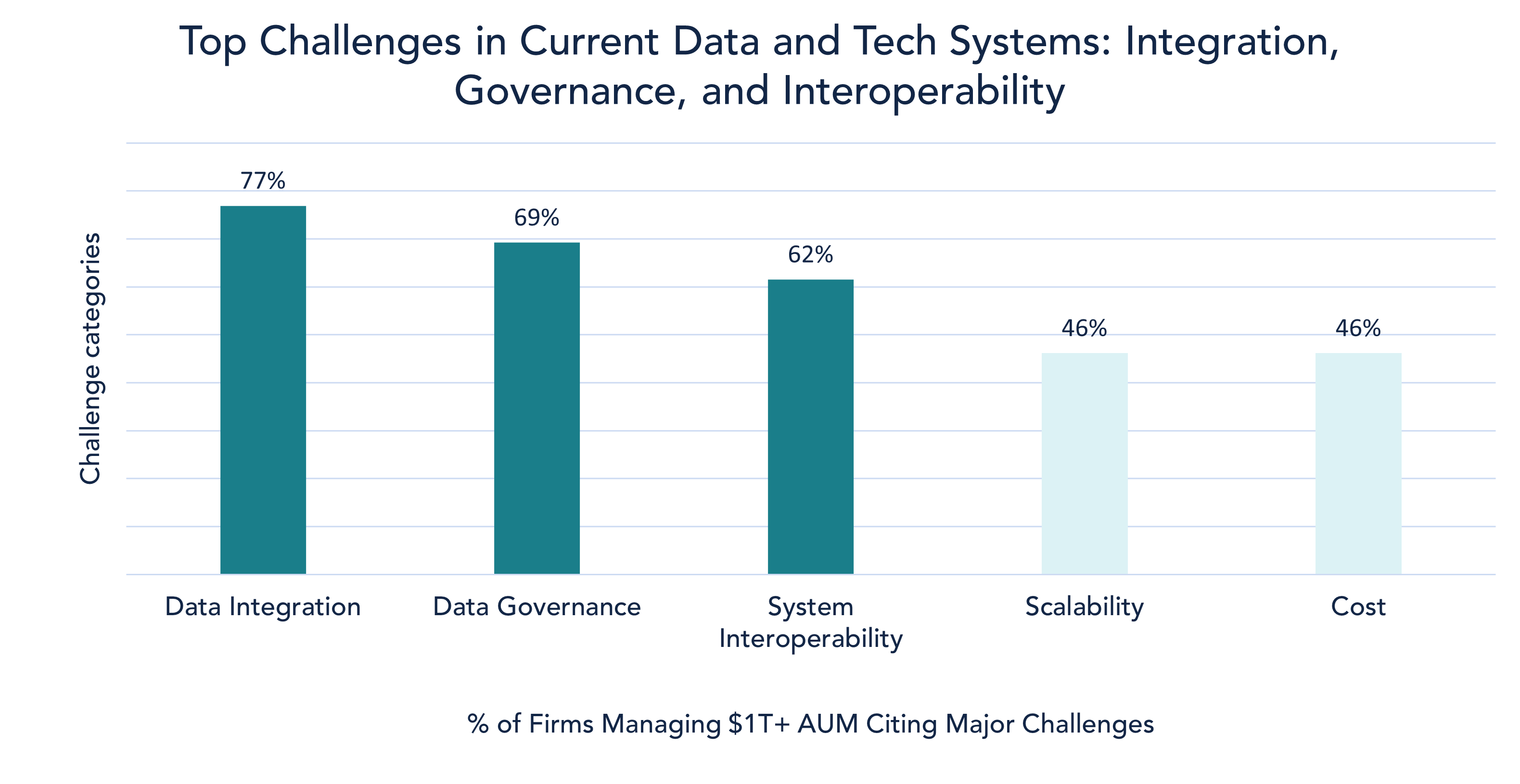
Proprietary tools often lack interoperability, making it difficult to connect systems and build scalable capabilities like those offered by modern SAAS and cloud-enabled platforms. Many of these systems were built decades ago and have accumulated layers of customization that now act as impediments to change. As experienced staff retire, the institutional knowledge required to maintain these systems is shrinking, increasing operational risk.
The cost of maintaining proprietary infrastructure is also rising. With fee compression and margin pressure across the industry, firms are under growing scrutiny to rationalize spend and improve efficiency. Proprietary systems, once seen as strategic assets, are now being viewed under the lens of risk, cost, and scalability.
Replatforming for Scale and Speed
Transformation programs are increasingly focused on replacing these systems not just for technical reasons, but to enable broader business capabilities such as unified data models, faster time-to-market, and readiness for AI deployment. In our survey, 30% of transformation initiatives among trillion-dollar firms included legacy system replacement as a core component.
As modernization efforts begin in the upstream functions of the front office, they often expose downstream dependency limitations that make legacy system replacement not only beneficial but often essential for front-to-back processes. This cascading effect is prompting a more holistic view of transformation, where changes in one area (such as to the investment book of record) necessitate rethinking adjacent systems, data flows, and integration layers. Growth ambitions—especially those tied to supporting new asset types, managing complexity, and delivering operational efficiency—require scalable, interoperable platforms that can span the full investment lifecycle.
These limitations are most visible in core investment functions, where legacy systems are being actively replaced.
For trillion-dollar firms, the most immediate targets include:
- Performance measurement and attribution, where legacy tools often lack flexibility to support multi-asset views and private asset workflows.
- Portfolio risk systems, which need to accommodate new asset classes and deliver real-time analytics across increasingly complex portfolios.
- Portfolio management platforms, where integration with trading, compliance, and data layers is essential for scale.
- IBOR (investment book of record), which provides the glue to facilitate the aforementioned functions, is often fragmented across legacy systems.
Each of these areas carries its own dependencies, and firms must carefully assess how upstream changes will impact downstream processes. For example, leveraging common data sets across functions will enable greater consistency and reduce reconciliation exceptions.
Data Architecture and Practices are the First Dominoes
Data is a critical backbone to transformation efforts. Yet today, data governance and operations are often reliant on manual processes and legacy technology.
For 69% of trillion-dollar firms, data governance is managed by third-party systems, but 1-in-3 are augmenting its data-oriented processes with spreadsheets. On the other hand, data operations leans heavier on homegrown solutions, with more than half relying on proprietary systems and the majority augmenting that in-house tech with third-party solutions.
Reflecting this mixed current state, 92% of firms with more than $1T plan to transform governance or operations over the next three years, and 69% anticipate change in both areas.
This brings data architecture and integration to the fore, where foundational work is essential to normalize disparate data sources, enable unified data models, prepare for advanced capabilities like AI, and enhance total portfolio view.
Data changes across the operating model
Firms’ commitment to replacing legacy systems across core functions remains steady over the survey's time horizon.
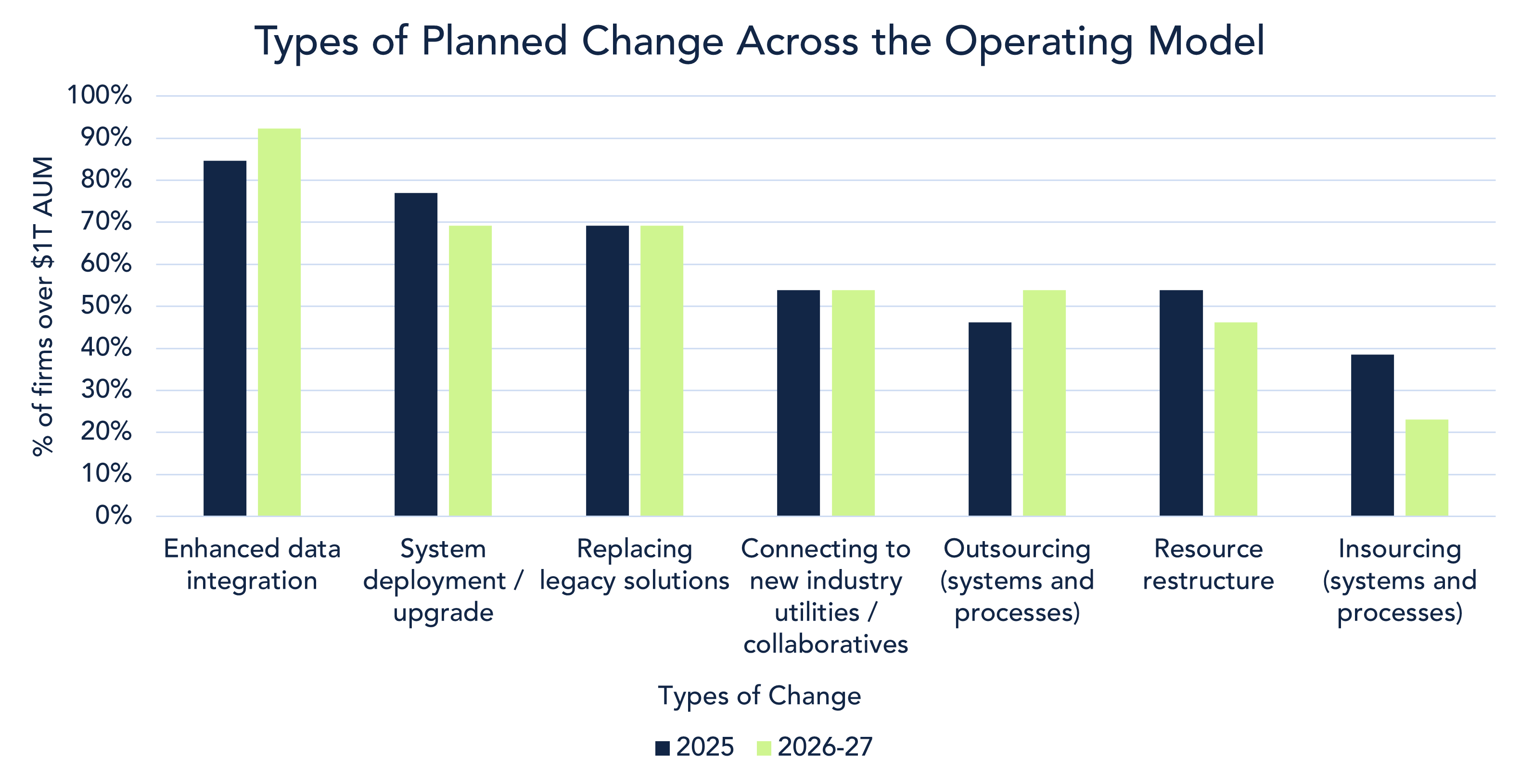
In data functions, this trend is equally consistent where changes are planned. However, by 2026–27, the focus shifts towards enhancing data integration, optimising system deployment, and restructuring resources, laying the groundwork for scalable analytics and automation.
This holistic approach ensures that firms don’t just adopt new technologies, they build the operational maturity to sustain them. A modern data foundation is critical not only for performance and risk management, but also for supporting private asset workflows, enabling TPV (total portfolio view), and training AI models with clean, consistent data.
The Vendor Landscape: Trending toward Front-to-Back Platforms with Unified Data Capabilities
Solutions like Snowflake and Databricks are increasingly core to the data architecture of major industry vendors. These cloud-native platforms don’t solve core business functions directly, but they do underpin scalable, unified data foundations required for transformation. Most asset managers aren’t adopting Snowflake or Databricks in isolation; instead, they are leveraging these tools through their chosen vendors, who have made them central to their own offerings.
At the same time, consolidation among software vendors is accelerating. But the narrative isn’t as simple as a wholesale move from best-of-breed tools to fully integrated front-to-back platforms. For every asset manager or vendor espousing a front-to-back approach, there’s another doubling down on best-of-breed, or even reverting back after experimenting with F2B. The reality is that most firms are seeking “integrated consolidated platforms,” solutions that balance interoperability, scalability, and flexibility, rather than rigidly adhering to one model.
The shift reflects a desire for simplification and strategic alignment. Rather than stitching together disparate tools, firms are seeking platforms that can support multiple functions, reduce integration overhead, and future-proof their operating models. The journey is far from linear, however, and the market continues to see a mix of approaches—integrated, best-of-breed, and hybrid strategies—depending on each firm’s needs and legacy constraints.
What Comes Next: Planning for Legacy Replacement
Launching a legacy or proprietary system replacement initiative is not just a matter of choosing new systems, it requires deliberate planning across technology, operations, and culture.
Before initiating change, firms must assess their readiness for transformation. Legacy systems are often deeply embedded in workflows, with long-tenured bespoke configurations that resist quick replacement. Change management planning is essential, not only to ensure adoption, but to mitigate disruption across teams and processes.
Data strategy is another critical consideration.
|
"Unified data architecture is the consolidation of data into one comprehensive and centrally managed structure. This means that data from different systems is organized into one common structure, allowing the organization to understand and process the data faster and more efficiently. UDA also helps organizations create efficient workflows and standardize their processes." |
Many proprietary systems rely on non-standard data models that don’t align with modern integration requirements. Without a clear approach to data normalization and governance, firms risk replicating fragmentation in new platforms. A unified data architecture must be in place before downstream capabilities like AI or TPV can be deployed effectively.
Vendor selection also demands a strategic lens.
Functionality alone is no longer the benchmark; firms must evaluate scalability, interoperability, and long-term viability. Consolidated platforms reflect a desire to reduce integration overhead and future-proof operations, but it also requires careful alignment with business goals and operating model design.
Finally, firms must consider the skills and resources needed to support new technologies.
Legacy replacement will introduce new tooling, data flows, and governance structures. Internal teams will need to be reskilled, and external support may be required to accelerate delivery and ensure best practices.
The decisions made in 2025–2026 will define firms’ ability to scale, compete, and innovate in the years ahead. Legacy systems are being retired. Data is being rearchitected. And the foundations for emerging technologies are being laid. Success will depend not just on what firms replace, but on how they prepare to transform.
Tags:


Ken Barnet
Ken provides strategic direction and leadership on Citisoft programs in North America and globally. He has over 30 years of experience providing both advisory and delivery services to asset managers and service providers of all sizes. Ken is a leader of complex, enterprise-wide programs, with specialties including strategic IT and operational assessments, operating model transformations, operations outsourcing transitions, and vendor software selections and implementations. His expertise spans asset classes ranging from equities and fixed income to derivatives and alternatives, and functional areas covering front, middle, and back office.
.png?width=200&height=200&name=Blog%20-%20Featured%20Images%20-%20500%20x%20500%20(9).png)
.png?width=200&height=200&name=Blog%20-%20Featured%20Images%20-%20500%20x%20500%20(5).png)
Comments